A Secret Dance in the Dark
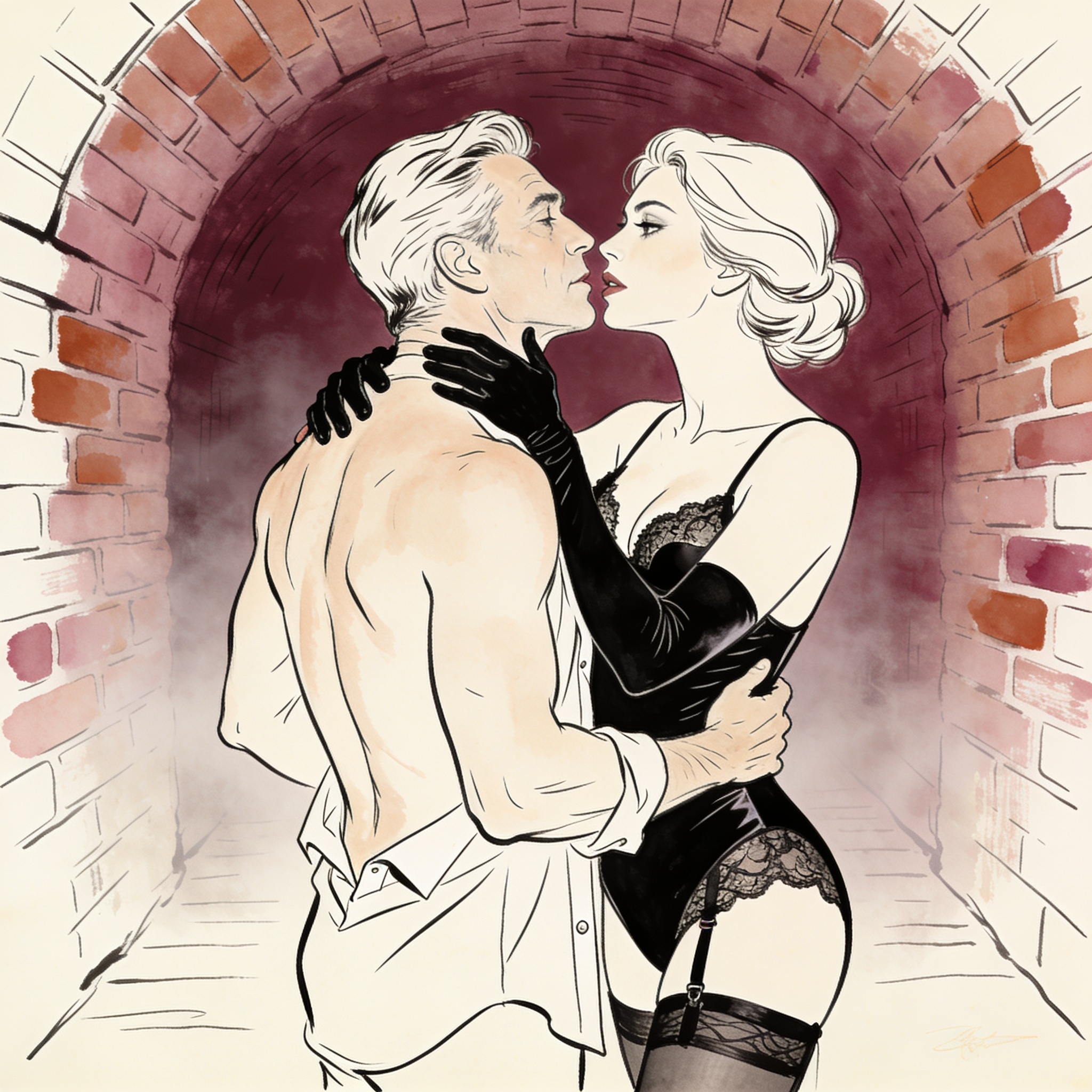
# Starcrossed ## Part 1: Sidekick and Slave ## Chapter 1– The Dynamic Duo ## Nick The rain over Gotham didn’t fall; it seeped. A cold, greasy mist hung in the air, coating the gargoyles and fire escapes with a phosphorescent sheen from
Chapter 1
The rain over Gotham didn’t fall; it seeped. A cold, greasy mist hung in the air, coating the gargoyles and fire escapes with a phosphorescent sheen from the neon below. From my perch on a crumbling cornice, I could see the whole diseased artery of the Bowery. It was a beautiful, terrible orchestra—the distant wail of a siren, the low murmur of traffic, the tinny laugh track from a television in a top-floor apartment.
And below, moving with a predatory silence that made the hair on my arms stand up, was Batman.
He was a shadow dislodged from the bricks, a swift, decisive cut through the fabric of the night. I watched him for a moment, a familiar warmth battling the chill in my bones. He was my north star. He was also the wall I kept trying to scale.
With a breath that tasted of damp wool and ozone, I pushed off. The world became a blur of wet stone and sudden, thrilling drops. The grapple gun was an extension of my arm, the line a silver thread I wove between rooftops. I landed on a lower ledge, my boots finding purchase on slick concrete with a soft *thud*. I was faster than him. More fluid. Where he was power and precision, I was instinct and improvisation. It was our dance. Tonight, it felt like we were dancing to different music.
A guttural roar, more animal than human, tore through the symphony of the city. It came from the mouth of a storm drain, a black gash in the foundation of a condemned textile factory. Batman didn’t hesitate. He melted into the darkness of the opening, a cape swallowing a cave.
I followed, the cheerful yellow of my tunic feeling suddenly garish against the oppressive gloom. The sewers of Gotham were a universe unto themselves—a warm, reeking womb of the city. The sound of rushing, filthy water echoed off curved brick walls. Our path was lit by the narrow beams from our cowls, cutting cones of light through the swirling mist.
Batman’s plan was simple, communicated in terse gestures: flush, contain, subdue. Killer Croc was holed up in a junction chamber ahead. A tactical, controlled approach.
Then I heard it. A whimper.
It was faint, almost lost beneath the drip of water and Croc’s agitated snorting. My light swept away from Batman’s path, probing a side tunnel choked with debris. There, pinned under a fallen pipe, was a woman. Her eyes were wide with a terror so pure it was almost peaceful. A civilian. A stray piece in Alex’s chess game.
Batman’s hand shot out, a black gauntlet clamping on my shoulder. His grip was iron. He pointed forward, toward the plan, toward the monster.
My heart hammered against my ribs. I looked at his cowl, at the white lenses that gave nothing away. I thought of all the lectures in the cave, the endless drills, the mantra: *The mission comes first. Discipline saves lives.*
But the woman’s whimper came again, a thread of sound in the monstrous dark.
I nodded at Batman. Then I moved.
Not forward. To the side.
In a single, fluid motion, I slipped from his grasp, rolled under the pipe, and was at her side. The world narrowed to the physics of leverage, the strain of muscle against cold, wet iron. The pipe groaned, shifted. “Look at me,” I said, my voice low but clear under the mask. “Just at me.” Her eyes locked onto mine, brown and drowning. With a final heave, the pipe gave way. I pulled her free, a tangle of trembling limbs, and shoved her toward the tunnel mouth. “Run. Don’t look back.”
She scrambled into the darkness just as another roar shook the bricks loose from the mortar. Croc had sensed the disturbance.
What followed was not in the playbook. It was a frantic, acrobatic skirmish in the claustrophobic space. I used the environment—swinging off pipes, kicking off walls, using his brute lunges against him to send him stumbling. It was messy, dangerous, and utterly instinctive. When Batman finally entered the fray, it was over in seconds. A well-placed taser cartridge, a twist of an arm, and Croc was down, groaning.
The silence that followed was worse than the roar. The only sound was the drip of water and our own breathing.
We hauled Croc to the waiting GCPD paddy wagon on the surface. The rain had softened to a drizzle. The woman was gone, absorbed by the city. A good outcome. A life saved, a monster caged.
As the police cruiser pulled away, Batman turned to me. The rain gleamed on the black of his cowl. “We had a plan.”
“There was a variable,” I said, trying to keep my voice even. The adrenaline was fading, leaving a cold hollow in my gut.
“The variable was accounted for. Croc was the priority. Your deviation could have gotten you killed. Or her.”
“But it didn’t.” The words came out sharper than I intended. “I saw an opportunity to save a life *and* complete the mission. I took it. It worked.”
He took a step closer. The aura of him—the sheer, imposing weight of his presence—was a physical force. “It was a reckless, emotional decision. You acted on impulse, not strategy.”
“Maybe strategy needs impulse sometimes!” I shot back, my hands curling into fists at my sides. “You taught me to see everything, Alex. To assess, to adapt. I assessed. I adapted. I’m not the kid in pixie boots anymore. I can handle the field. I *proved* it tonight.”
The name hung in the damp air between us. A breach of protocol. A plea.
He was silent for a long moment. When he spoke again, his voice was lower, stripped of the Batman growl, but somehow colder for it. “Proving it isn’t the point. My responsibility isn’t to your skill. It’s to your life. Every time you go off-script, you roll dice I’m not willing to gamble.”
The words landed like a blow. It wasn’t about trust in my abilities. It was about his fear. His guilt. The ghost of a little boy in a dark alley that he could never, ever fail again.
I loved him. I would follow him into any hell. I just wanted him to see me, to really see the man standing beside him in the rain, and not the reflection of the broken child he’d picked up all those years ago.
“I know,” I said finally, the fight draining out of me, leaving only a weary ache. “I know what I mean to you. But I can’t… I can’t stay twelve years old in your head forever.”
He didn’t answer. He just turned, his cape sweeping a wide arc, and vanished into the shadows between two buildings, leaving me alone on the glistening rooftop.
The city stretched out before me, endless and hungry. Somewhere out there, in the vast, strange cosmos, there were other lights, other ways of fighting, of living. I felt a sudden, vertiginous pull toward the unknown—a yearning for a sun that wasn’t shrouded in perpetual cloud, for a warmth that wasn’t born from friction and conflict.
But that was a dream for another night. Tonight, Gotham was my home. And I was still Robin.
I took a running start and leaped into the darkness, the city’s cold breath on my face, the echo of an unresolved argument pacing me like a ghost. The tension thrummed in my veins, a restless energy with nowhere to go. It simmered beneath the skin, a promise of storms yet to come.
Chapter 2
The light of Tamaran’s three suns was a symphony against my skin. It did not simply shine; it sang, a warm, three-part harmony that soaked into my orange flesh and made my very blood hum. From my balcony in the Royal Spire, I could see the city of Tamarand spread below, a cascade of crystalline towers and floating gardens threaded with silver rivers. The air smelled of sweet pollen and ionized energy, the breath of a world alive and thriving.
“Koriand’r! Are you dreaming again?”
The voice was a familiar, amused baritone. I turned, a smile already blooming on my face. My father, King Myand’r, stood in the arched doorway, his ceremonial armor reflecting the midday light. He was a mountain of a man, but his eyes, the same vibrant green as my own, were soft.
“Only of how beautiful our home is, Father,” I said, leaning into the embrace he offered. His presence was a steady, gravitational pull, safe and absolute.
“A princess should dream of more than beauty,” he said, but his tone was warm. “She should dream of duty. And your duty this afternoon is to greet the envoys from the Southern Atolls with your sister. Your mother and I have a council meeting.”
I nodded, the thrill of a real responsibility quickening my pulse. “Of course. Where is Komand’r?”
A subtle shift in the light behind my father’s eyes. A momentary dimming. “She awaits you in the Hall of Ancestors. Try to… set a steady pace for her, Kori. Your enthusiasm is a beacon, but it can cast long shadows.”
I did not fully understand, but I tucked the words away. I kissed his cheek, the energy of our familial bond a pleasant spark against my lips, and hurried from the chamber.
The palace was a living extension of our family. Its walls pulsed with a gentle, bioluminescent glow, and the paths through its vaulted halls were guided by streams of floating, phosphorescent spores. I found my sister standing before the great mosaic of our lineage, her back rigid. Komand’r was taller than me, her frame sharper where mine was curved, her black hair cut in a severe, elegant line that contrasted with my own wild red mane.
“You are late,” she stated, not turning.
“Forgive me,” I said, coming to stand beside her. I reached out to take her hand—a simple, affectionate gesture I had performed a thousand times.
She pulled her hand away as if my touch were acidic.
The rejection was a small, cold shock. I let my arm fall. “Komand’r? What is wrong?”
She finally looked at me. Her eyes, so like mine, held none of the warmth. They were chips of green ice. “Nothing is wrong, sister. I am simply prepared for our task. Are you? Or will you be too busy basking in the adoration of the crowd to remember the proper forms of address?”
Her words were sharp, intended to cut. I felt only confusion. “I have studied the forms. We will perform them together. It will be fun!”
“Fun,” she repeated, the word flat and dead. “Of course. For you, everything is fun. The people cheer your name. Father beams when you enter a room. Even the very suns seem to shine for you alone, Koriand’r.” She turned back to the mosaic, to the images of queens and warriors from our bloodline. “You have never had to fight for a single thing you possess.”
The accusation was so vast, so incomprehensible, I could not find its edges. Fight? What was there to fight for? We were a family. The throne was our shared inheritance, a future we would uphold together.
“I do not understand,” I said, my voice quiet. “We have everything together.”
Komand’r’s laugh was a short, brittle sound. “You truly don’t, do you? That is the most galling part.” She swept past me, her shoulder deliberately brushing mine. “Come. Let us go and perform our ‘fun’ duty. The people await their favorite princess.”
We rode a flow-disc down to the Grand Atrium. As the platform descended, the roar of the crowd rose to meet us. Thousands of Tamaraneans filled the space, their faces upturned, their hands raised in the traditional salute, palms glowing with shared starlight.
The moment we stepped onto the dais, the tenor of the roar changed. It deepened, warmed. I heard my name woven into the sound—“Koriand’r! Princess Kori!”—and I could not help the radiant smile that spread across my face. It was not vanity; it was joy. A pure, uncomplicated exchange of love with the people I was born to serve.
I raised a hand in greeting, and a wave of answering light rippled through the crowd.
Beside me, Komand’r stood perfectly still, her own salute crisp and correct. No one chanted her name. The difference was not subtle. I felt a pang of guilt, then a rush of impulsive generosity. I stepped closer, linking my arm with hers, pulling her into the spotlight with me. “They cheer for us both, sister!” I said over the din.
She did not pull away this time. She simply let her arm lie stiffly in mine, a mockery of unity. When I glanced at her profile, her expression was smooth, composed, and utterly vacant.
The ceremony proceeded. We greeted the envoys, accepted their offerings, spoke the ceremonial words. I did my best to share every look, every gesture, with Komand’r. She performed flawlessly, a masterpiece of royal poise. And yet, a hollow space seemed to open between us, a vacuum where our sisterhood should have been.
Later, in the silence of her chambers, I tried again. I brought her a vial of luminous nectar from the royal gardens, a thing we had both loved as children. “I thought we could share it,” I said, offering it. “Like we used to.”
She took the vial, her long fingers closing around it. For a heartbeat, I saw something flicker in her eyes—a memory, perhaps, of a simpler time. Then it was gone, extinguished.
“You are so careless with your affections, Koriand’r,” she said softly. “You scatter them like seeds, assuming every one will grow. You have no idea what it is to hunger for a single drop of what flows so freely for you.” She placed the unopened vial on a shelf, a trophy of a kindness she would not accept. “Keep your nectar. I have no taste for it.”
That night, as I lay in my bed, the words echoed. *Long shadows. Fight for what you possess. Hunger.* I stared at the shimmering canopy above, the peaceful hum of the city a gentle lullaby beyond my windows. Political unrest was whispered about in the lower councils, talk of factions and discontent. I knew this. But such things were like distant storms, threats that could not possibly breach the walls of our spire, the strength of our family.
Komand’r was my sister. We shared blood, history, a destiny. Her coldness was a passing season, a mood I could warm with enough love. The idea that her resentment was a deep, structural flaw in the foundation of my world was unthinkable. The future was a bright, open sky. We would fly into it together.
I closed my eyes, the smile returning to my lips as I dreamed of tomorrow’s adventures, blissfully unaware that the ground beneath my happy feet was already beginning to crack.
Chapter 3
Gotham smells different during the day. Less like rain and desperation, more like ozone and stale coffee. The sun was a pale, watery smear behind the perpetual cloud cover as I leaned against the brick wall of a defunct sweatshop in the Bowery, my boots scuffing the damp pavement. The din of the city was a steady, living hum around us.
“He’s not working alone.”
Batman didn’t look at me. His focus was on the grimy window of a storefront two doors down, a place that had once sold mannequins and now sold nothing but dust. “The pattern is chaotic. Purposefully so. Pyg thrives on disorder.”
“That’s the misdirect,” I said, pushing off the wall. I’d been turning the case over in my head since the briefing in the Cave. The files on Professor Pyg were a litany of grotesque artistry—victims turned into his twisted “dollies” through surgery and psychological terror. But the locations were all wrong. “The chaos has a center. He needs space, clean space, for his… work. These abductions are happening near meatpacking districts, but the dump sites are miles apart, in residential zones. He’s transporting them. He has a van.”
“We’ve canvassed every registered refrigeration vehicle in a five-mile radius,” Alex said, his voice that low, patient monotone he used when explaining fundamentals. “Nothing.”
I shook my head, the movement sharp with frustration he couldn’t see under my domino mask. “He wouldn’t use a refrigerated truck. Too obvious, too trackable. He’d use something that blends. Something that moves through the city unseen.” A memory flickered—a case file from last year, a different perp. “Like a laundry service. Or a dry-cleaning delivery van. They’re everywhere. No one looks twice.”
He finally turned his head, just slightly. The white lenses of his cowl were inscrutable. “A theory.”
“It’s more than a theory. The second dump site was behind a laundromat on Sprang Avenue. The uniforms they found on the first victim had chemical burns, but they weren’t industrial. They were from perc… perchloroethylene. Standard dry-cleaning solvent.” The pieces clicked together in my mind with a satisfying, almost audible snap. I’d spent three hours cross-referencing chemical databases after patrol last night. Alex had told me to get some sleep.
He was silent for a long moment, processing. I could almost hear the gears turning in his head, weighing my logic against his own methodology. “There are dozens of dry-cleaning services in that radius.”
“But only one,” I said, pulling out my portable Bat-computer—a sleek, modified tablet Alfred helped me build, “that also owns a private garage listed under a shell corporation called ‘Doll’s House Enterprises.’ I ran the property records an hour ago.” I turned the screen toward him. The map was marked with a single, pulsing red dot in the Industrial Corridor.
He looked at the screen. Then he looked at me. The silence stretched, thick and heavy. I saw it then, the subtle shift in the line of his jaw. He’d already been moving in that direction. He’d likely identified the same garage twenty minutes ago. But I’d said it first. I’d connected the dots and laid it at his feet.
He didn’t say “good work.” He didn’t clap me on the shoulder. He simply gave a curt nod. “We move tonight. Surveillance protocol Delta. You observe the south entrance. Report movements. Do not engage.”
The words were a door gently but firmly closed in my face. I wasn’t a partner offering a breakthrough. I was the apprentice being given an observation post. The victory of solving the puzzle turned to ashes in my mouth.
* * *
The operation was flawless. We watched the garage. Pyg arrived just after midnight in a nondescript white van with “Fresh & Clean” stenciled on the side. We moved in, a synchronized blur of darkness. The takedown was quick, clinical. I disabled two of his henchmen with a sweep of my escrima sticks while Batman descended on Pyg himself. In five minutes, it was over. The GCPD found three terrified, unharmed victims in the back, prepped for surgery but untouched.
Back in the Cave, the silence was louder than any argument. I pulled off my mask, running a hand through my sweat-damp hair. The hum of the supercomputer was a constant drone.
Alfred appeared with a tray, two glasses of water. His eyes, sharp and kind, missed nothing. “A successful evening, Master Nick.”
“He didn’t listen,” I said, the words coming out in a rush. “I gave him the answer. I solved it. And he still handed me the simplest watch detail like I was… like I was still the kid who needed to be kept on the sidelines.”
I took the water, drinking deeply. The cave’s chill seeped into my bones.
Alfred began tidying the medical bay, his movements precise. “Master Alex operates from a calculus of loss, not of growth. He is, one might say, a master of rescue operations. Ensuring you remain within the perimeter of his protection is a mission he understands perfectly.” He paused, polishing a gleaming scalpel. “Allowing you to step beyond that perimeter, to truly fly on your own… that is a mission for which he has no playbook. It requires a kind of trust that feels, to him, like a surrender.”
“I don’t need him to surrender,” I muttered, leaning against the console. “I just need him to see me.”
“He sees you, Master Nick. Quite clearly.” Alfred’s voice was gentle, final. “He sees the boy he brought home. And every day, that boy looks more like a man ready to leave. For a man who built his life around preventing loss, that is the most terrifying case file of all.”
He left me then, with the water and the quiet hum of the Cave. I looked up at the giant T-Rex, a monument to a past I hadn’t lived. Alex knew how to save people. He just didn’t know how to let them go.
Above, through the cavern ceiling, I imagined I could see the cold pinpricks of stars. And for the first time, the thought of flying toward them, alone, didn’t feel like a betrayal. It felt like breathing.
Chapter 4
I could smell the smoke before I saw it. Not the clean, ceremonial smoke of the festival pyres, but a bitter, chemical tang that clawed at the back of my throat. It seeped under the door of my chambers, a grey ghost carrying whispers of wrongness.
I rose from my meditation cushion, the gentle hum of my own bio-energy suddenly discordant. The palace was too quiet. The usual pulse of footsteps, the distant murmur of courtiers, the song of the spire’s living lights—all were absent. There was only the deep, vibrating silence of a held breath.
A scream tore it apart. It came from the lower halls, cut short.
My heart was a frantic bird in my chest. *An accident. A malfunction in the energy core.* I rushed to the door, my hand glowing with defensive power almost without thought. The door did not open at my touch. It was locked from the outside. Not just locked—sealed. A cold, administrative seal glowed on its surface, one I recognized from high-security vaults.
“Hello?” I called, pressing my palm against the barrier. “What is happening? Open this door!”
The only answer was the sound of armored boots marching in unison past my threshold. My sister’s personal guard.
A terrible understanding began to dawn, slow and thick as cooling magma. I refused it. Komand’r? No. It was unthinkable. She was sharp, she was distant, but she was my blood. This was some external threat she was mobilizing against. She had sealed me in for my own protection.
I heard her voice then, amplified by palace comms, echoing through the stone halls and into my prison.
“People of Tamaran,” her tone was clear, calm, authoritative. “A sickness has festered in our court. A weakness masked as warmth. It ends now.”
My breath stopped.
“My sister,” she continued, and the word sounded like a curse on her lips, “has conspired with foreign elements to undermine our strength from within. Evidence has been presented to the royal council. Her reign of careless influence is over.”
Lies. Every word was a beautifully crafted lie. I slammed my fist against the door, a burst of green starbolt energy scarring its surface but not breaking through. “Komand’r! Stop this! Whatever you believe, we can speak!”
The marching boots halted outside my door. The seal dissipated. It slid open.
She stood there, framed by six guards in full battle armor. She wore our mother’s ceremonial greaves and pauldrons, pieces she had no right to yet. Her expression was one of serene pity.
“Hello, sister,” she said.
“What are you doing?” My voice trembled with confusion more than fear. “What is this ‘evidence’? Who has done this?”
Her green eyes held mine, and for the first time, I looked into them and saw nothing of myself reflected back. Only a vast, calculating emptiness. “You have done this, Koriand’r,” she said softly. “By being everything you are. Your existence is the conspiracy.”
The guards moved.
I did not want to fight them. They were Tamaraneans. My people. Misguided, perhaps, following orders they believed were just. I deflected blasts with shields of solid light, I disarmed one with a careful telekinetic twist that sent his weapon clattering harmlessly away, I used my agility to daze another with a non-lethal photon burst to his helmet sensor array.
I could have done more. So much more. A concussive blast could have shattered their armor and their bones. A focused beam could have cut through them like a hot wire through mist. The power sang in my veins, begging for release to protect myself, to protect my home from this madness.
But I could not. I would not spill Tamaranean blood. My hesitation was a second too long. A neural inhibitor net, weighted and cold, launched from a projector behind Komand’r. It wrapped around me, its conductive fibers instantly dampening my bio-energy, sapping the strength from my limbs. I fell to my knees, the vibrant orange glow of my skin guttering out like a dying ember. The net tightened. And just like that, I was captured.
They dragged me not to the dungeons, but to the throne room. Our father’s throne.
Komand’r did not sit in it. She stood before it, as our bound and gagged parents were brought in by more of her loyalists, their eyes wide with heartbreak and fury over their silencers. “See?” Komand’r announced to the assembled traitor-court. “The source of the contagion. Neutralized.” She finally turned her gaze down to me, where I knelt on the cool crystal floor, powerless. “Any last words, beloved sister?”
I strained against the net, my voice raw “Why? Why do this?”
She knelt then, bringing her face close to mine, her whisper for me alone. “Because you were born first.” She said it like it explained everything. And in its monstrous simplicity, it finally did. This wasn't about politics or slights or philosophies. It was about a sun that chose to shine on one daughter first, and a second daughter who decided to eclipse it forever.
She rose, addressing the room. “Execution would be wasteful,” she proclaimed, her voice dripping with false magnanimity. “A dead princess becomes a martyr—a symbol for malcontents to rally around.” She looked back at me, a chilling smile touching her lips. “A disappeared princess… becomes irrelevant.” Her sentence settled over me like a physical shroud.
She nodded to a guard whose armor bore unfamiliar markings—mercenary sigils. Not Tamaranean. Off-worlder.
They hauled me to my feet, pulling me toward a service portal that led not to prison,
but to the star-docks. As I was pulled away,
my last sight of my home was Komand’r finally lowering herself onto our father’ s throne, the living light of Tamaran seeming to dim as she touched it.
The mercenaries shoved me into a sleek, windowless cargo shuttle smelling of stale fuel and alien metal. As the hatch sealed with a hydraulic hiss, plunging me into darkness save for a single red running light
the finality crashed down. Not death. But erasure. Sold off-world like surplus goods. My warmth extinguished not by blade, but by deliberate, absolute, forever, cold.
Chapter 5
The fire was real this time. Not a metaphor. Garfield Lynns had graduated from pyromania to full-blown arsonist theatre, and he was painting the Gotham skyline with napalm. From my perch on the old Monarch Theatre marquee, I watched the Batmobile streak down the avenue, a black shark parting a sea of orange heat and panic.
Alex’s voice crackled in my ear, cold and precise. “He’s herding emergency responders toward the gas main on Sprang. I’ll intercept at the choke point. You provide aerial distraction on my mark. Do not engage directly.”
I saw it too—the pattern of the blasts, the way Firefly’s jetpack weaved a specific, frantic tapestry in the sky. But I also saw what Alex’s tunnel vision on the main objective missed: a secondary, smaller ignition sequence starting on the roof of the adjacent tenement. Lynns wasn’t just herding first responders; he was creating a firebreak to trap them. The gas main was the big play, but the rooftop inferno was the closing door.
“Robin. Acknowledge.”
“I see a secondary containment fire on the tenement roof,” I said, already calculating the swing. “If I don’t vent it now, FD gets boxed in.”
“The priority is Lynns and the main. Maintain your position.”
The order was absolute. The logic was flawless, if you ignored the six firefighters who would be roasted alive because of it.
I didn’t acknowledge again.
My grapple shot out, not toward Alex’s prescribed coordinates, but across the searing gap between buildings. The heat hit me like a physical wall, sucking the air from my lungs. I landed on the blistering tar paper, the flames already licking up the ventilation shafts. It was a simple maneuver, in theory—blast the sealed water tank on the roof’s edge with a batarang, create a downpour. But it had to be done now.
I did it. A shriek of rending metal, a geyser of stale water that hit the flames with a furious hiss. The containment fire guttered out, leaving a smoldering, passable path for the ladder truck now grinding to a halt below.
By the time I swung back to the main event, it was over. Batman had Lynns wrapped in his own extinguisher foam, a smoldering heap on the asphalt. The gas main was secure.
We stood on a rooftop an hour later, the acrid smell of wet ash clinging to everything. The adrenaline was gone, leaving that familiar hollow.
“You broke position,” he said. His voice was quiet. That was never a good sign.
“I saw an opening you didn’t account for,” I replied, pulling off my mask to feel the cold air on my face. “I took it. The fire crew on Baker Street is alive because of it.”
“I gave you an order.”
“And I made a call!” The words burst out of me, hotter than Firefly’s flames. “A call based on the assessment skills you drilled into me for eight years! You trained me to see the whole board, Alex. To think for myself. You can’t… you can’t spend a decade forging a weapon and then get angry when it cuts something you didn’t point it at.”
He turned fully toward me then, and even without the cowl’s lenses, I could feel the weight of his stare. It wasn’t anger I saw in the tight line of his mouth. It was fear. The same fear that kept the walls of the Cave so high. “Thinking for yourself isn’t the same as acting alone. Deviation without communication gets people killed. It got *your parents* killed.”
The air left my body. He never went there. It was the one line, the unbreakable rule.
The divide between us wasn’t just widening. It cracked open into a chasm, and I was staring across it at a man who would forever see me as someone to protect from a fall that had already happened.
“I’m not them,” I said, my voice dangerously calm. “And I’m not you.” I turned my back on him, on Gotham’ endless, grinding shadow-play, and looked up. Past the smoke, past the light pollution, the stars were out. Cold, distant, and utterly silent.
For the first time, that silence didn’t feel lonely. It felt like an answer.
Chapter 6
The metal of the collar was cold, a constant, hateful pressure against the warmth of my skin. I stood on the auction block, the strobing lights of the Gordanian slave market beating down on me. I refused to look at the gathered crowd of traffickers and scum, their hungry eyes crawling over my exposed body. I stared straight ahead, my back straight, my chin held high.
“I am Koriand’r,” I declared, my voice ringing clear above the auctioneer’s droning catalog of my… assets. “Princess of Tamaran. Daughter of the Royal House. You commit an act of war.”
A Gordanian guard, his scales dull under the lights, lumbered up the steps. He carried a neural lash. “Assume the presentation posture,” he grunted, the words mangled by his snout.
“You will not command me.” My green eyes flashed. “Release me, and I may petition for your lives to be spared.”
He swung the lash. A bolt of white agony seared across my thigh. I did not cry out. I lunged. My fist connected with his jaw with a satisfying crack. I was on him, a whirl of orange limbs and fury, using the heavy chain between my wrists as a garrote. Two more guards converged. I fought. I broke one’s nose with a savage headbutt before a shock-prod rammed into my ribs.
The voltage was a supernova inside my bones. I collapsed, twitching, the taste of ozone and blood in my mouth. They dragged me to a holding cell, throwing me onto the filthy floor. I pushed myself up immediately.
“You are fools,” I spat at the retreating backs. “My sister will burn your worlds to cinders for this insult. I am Princess Koriand’r!”
The only reply was the hiss of the force field sealing me in.
Later, when a slaver with too many hands reached through the bars to adjust my collar, I bit him. I tasted his foul blood and felt a grim triumph. He backhanded me, splitting my lip. “Feisty stock,” he snarled to a companion. “Will need breaking.”
“You are breaking nothing,” I said, wiping my mouth. “You are only ensuring your own extinction. My title is not for you to erase.”
I plotted escape. When they moved me for “processing,” I feigned weakness, then erupted into motion. I made it seventeen steps into a dank service corridor, my heart a wild, hopeful drum, before a net of energy dropped over me. The convulsions this time left me helpless, weeping with frustration as much as pain.
They dumped me back into a common pen. I lay there, breathing hard, my spirit a raw, bleeding thing. An older human woman with haunted eyes shuffled over. She offered me a sip of tepid water from a communal bowl.
I refused to take it from her hands. “They will bring me water in a vessel befitting my station,” I said, my voice trembling with exhausted defiance. “I am Koriand’r, Princess of Tamaran. I do not drink like an animal.”
The woman stared at me for a long, silent moment. Then she let out a sound—a dry, broken laugh that held no humor at all.
“Sweet girl,” she whispered, her voice raspy with disuse. “No one here cares.”
The words did not strike me. They simply… were. And in their wake, the world did not crack or shatter. It went utterly, profoundly silent. The constant internal hum of my birthright, the psychic weight of my title, the unshakable truth of *who I was*—it vanished. It did not matter. It had never mattered here.
My royal blood, my lineage, my very name… it was not a shield. It was not a weapon. It was a story I had been telling to an empty room. The Gordanians did not see a deposed princess. The other prisoners did not see a fallen sovereign. They all saw the same thing: a body. Orange skin. Red hair. A shape. Merchandise.
I looked down at my own hands, now trembling not from anger, but from a cold so deep it felt like my soul was freezing solid. For the first time in my life, I was nothing. The realization was a void, and I was falling into it, endlessly.
Chapter 7
The Cave was silent, a cathedral of shadows and echoes. The only light came from the main console, bathing Alex’s face in a cold blue pallor. He was sitting stiffly in the med-bay chair, a stark white bandage peeking from beneath his tunic. I stood before him, still in the Robin suit, the smell of smoke and fear clinging to the Kevlar.
He hadn’t said a word since I’d returned. He’d just listened, his eyes fixed on the mission logs as I’d detailed the night. The fire at the warehouse on Sprang Avenue. The false lead with the counterfeit bills. The final, brutal showdown with Cluemaster in the old botanical gardens. He’d been setting riddles wired to explosive charges in the greenhouses. It had taken me three hours to solve the last one, my fingers numb with cold and adrenaline, a hairsbreadth from a fireball that would have incinerated half the rare orchid collection.
I finished my report. The silence stretched, thick enough to choke on.
“He’s in GCPD custody,” I said finally, my voice too loud in the quiet. “The bombs are disarmed. No civilian casualties.”
Alex swiveled the chair slowly to face me. His expression wasn’t angry. It was worse. It was hollow. Disappointed. “I gave you a direct order.”
“I know.”
“You disobeyed it.”
“Yes.”
He leaned forward, his knuckles white where they gripped the armrests. “Why?”
I took a breath. This was it. “Because the city needed Robin. Because I could do it. Because…” I met his gaze, willing him to understand. “Because I *had* to know if I could.”
“And what did you learn?” His voice was a low rasp.
“That it’s hard,” I said, the words tumbling out now. “Harder than I thought. Every decision was mine. Every risk was on me. There was no one to watch my back, no one to call the play. Cluemaster got the drop on me twice. I had to improvise, and it was messy, and it was dangerous.” I felt a wild grin trying to break through the exhaustion. “And it was the most alive I’ve ever felt. I did it, Alex. I *won*. On my own.”
He just stared. The hope that had been burning in my chest began to sputter and die under that empty, analytical look.
“You see it, don’t you?” I pushed, my voice cracking. “You see what that means? Robin isn’t just your shadow. He can stand on his own. I can stand on my own.”
Alex stood up, wincing slightly as he put weight on his injured side. He walked past me to the console, calling up the security feeds from the botanical gardens. He froze the image on a shot from a thermal camera. It showed me, a small, bright figure, crouched beside the final bomb, Cluemaster’s henchman closing in from behind with a pipe.
“I see a deviation from protocol that nearly got you killed,” he said, his voice flat. “I see a concussion you’re hiding because your stance is off. I see a cut on your left forearm you haven’t treated.” He turned back to me. “I see disobedience. Recklessness. A failure to respect the chain of command.”
The words were like physical blows. “That’s all? After everything tonight, that’s *all* you see?”
“What did you expect me to see, Nick? A promotion?” He shook his head, a weary, final gesture. “You proved you’re a skilled fighter. You proved you’re clever. You did not prove you’re ready to operate independently. You proved you don’t listen.”
The finality in his tone crushed the last ember of hope. He wasn’t looking at the man who’d saved the city tonight. He was looking at the 10-year-old he’d pulled from a his parents murder, a liability he couldn’t afford to lose.
I understood then, with a clarity that felt like ice water in my veins. He would never voluntarily let me go. To him, my independence wasn’t an evolution; it was a threat. A threat to his control. A threat to the memory of the boy he’d sworn to protect.
“I see,” I said, my voice suddenly quiet. I turned and walked toward the locker room, the weight of the night—the triumph, the fear, the sheer electric joy of it—crumbling into ash.
“Where are you going?” he asked from behind me.
“To shower,” I said, not turning around. “I’m covered in Gotham.”
I didn’t add the rest of the thought, the one that echoed in the hollow space he’d carved inside me: *And I need to figure out what I am without you.*
Chapter 8
The transport pod shuddered as it docked, the sound of magnetic clamps sealing my fate. My new cage was not a cargo hold, but a gilded room in a private orbital station overlooking a bruised nebula. The air was thick with perfumed oils and the low thrum of transactional music.
My owner was a Gordanian broker named Zarnak. His scales glinted like dirty coins, and his eyes held no interest in me as a person, only as an asset to be broken and rented. He told me the nature of my duties. The words were clinical, outlining schedules, client expectations, and penalties for non-compliance. My skin crawled, a cold fire erupting beneath my orange flesh. I would not. I am Koriand’r.
When the first client arrived—a bulbous Tamerian with grasping, moist hands—I fought. My fist connected with his jaw in a burst of satisfying green starlight. My kick aimed for his thorax. It was a glorious, defiant explosion of the warrior I was born to be.
The punishment was not glorious. It was a neural whip, a lash of pure, silencing agony that bypassed muscle and bone to knot directly around my will. It dropped me, spasming, to the polished floor. Zarnak stood over me, dispassionate. The message was clear: rebellion was a luxury that carried a price in unbearable pain.
The anger did not leave. It calcified. It became a cold, dense star in my chest. I let my body go limp when they hauled me up. I stopped meeting their eyes. When the next client came, a nervous official from a mineral consortium, I did not strike. I turned my face away, my body rigid with disgust as his hands pawed at me. This, too, was unacceptable. The whip crackled again, a lesson in total submission.
So, I learned a new form of warfare. I made my eyes dull. I forced my lips into the ghost of a smile. I allowed my body to be positioned, my limbs moved like a doll’s. I feigned a broken spirit. Inside, the star burned hotter.
While hands groped and slobbered against my skin, my mind was a vault. I counted the steps of the guard outside the door. Twenty paces past, a thirty-second pause, twenty paces back. I tracked the blinking patterns on the security panel beside the irised doorway—three long, two short, a retinal scan for Zarnak only. I noted the faint vibration through the deck plates every forty-seven minutes: a supply shuttle docking on the lower ring. I listened to the chatter on the guards’ comms, piecing together shift changes and patrol routes.
My body was a map of degradation, but my mind was a clockwork trap. Every touch, every humiliating command, every second of forced compliance was another datum filed away. The exit was a pressurized airlock at the end of the hospitality wing. The control override was a six-digit code I saw a guard punch in once, his back turned. I saw it. I remembered.
The star in my chest had a new name: Escape. I would wear their compliance until it became my camouflage. I would memorize their routines until I could walk through them like a ghost. This cage, with its silks and its scourges, was just another system to learn, another enemy to outthink. And I would burn my way free.
Chapter 9
The cave was a cathedral of silence. The only sounds were the distant drip of water and the hum of the supercomputer, processing data on a city we’d just failed. The mission was a blur of fire and panic—a tenement rigged by Firefly. Batman’s order was clear: contain the primary blast zone. I saw the secondary fireball curl toward the exposed aerial ladder where two firefighters were trapped.
I didn’t think. I just moved.
Now, standing on the unforgiving stone, the smell of smoke still clinging to my uniform, I waited for the verdict.
He didn’t turn from the Batcomputer’s glow. His voice was low, a rumble in the hollow dark. “You ignored a direct command.”
“They were cut off,” I said, my own voice tighter than I intended. “The main stairwell was gone. Your plan didn’t account for that.”
“My plan accounted for the highest probability of survival for the most people. You accounting for two men nearly got you incinerated.” He finally turned. The cowl was off, but Alex’s face was a harder mask. “This isn’t a debate, Nick. It’s a fundamental rule. If you wear that uniform, you follow my orders. Without exception.”
The words hung there, absolute. The final brick in a wall I’d been trying to scale for years. I felt a strange calm settle over me, colder than the cave’s air.
My hands came up. The tips of my fingers found the edge of the domino mask, the familiar adhesive pull at my temples. I peeled it away slowly, the action feeling ceremonial, final. I let the black and yellow scrap of fabric dangle from my fingers for a moment before I dropped it. It fluttered to the stone floor between us, a tiny, insignificant splash of color in the gloom.
I looked straight at him. “What if I don’t?”
The question echoed softly. I saw it land. I saw the minute flicker in his eyes—not anger, but something far worse. A fissure of pure, undiluted fear. The fear of the man in the alley. The fear of the guardian who could not bear another loss. His jaw tightened, but no words came. He had a million arguments about tactics and safety and responsibility, but he had no answer for *that*.
He had no answer for my choice to simply stop being Robin. Or at least *his* Robin.
The silence was his answer. It was all the answer I needed.
I didn’t say goodbye. There was nothing left to say that wouldn’t just be noise. I turned my back on the Batcomputer, on the trophies, on the man who had been my father in everything but name. My boots were quiet on the ramp. I didn’t take the costume. I left it all there—the mask, the title, the ghost of the boy he’d adopted.
The manor was a tomb. My footsteps in the grand hall were the only sound. Alfred appeared at the top of the main staircase, a silent, sorrowful figure in the dim light. I met his eyes and gave a small, resigned shake of my head. His face fell, but he didn’t try to stop me. He understood.
The heavy oak door groaned as I pulled it open. The night air of Gotham rushed in, smelling of rain and diesel. It was the same air from the rooftops, but it felt different now. It felt free.
I didn’t look back. I just stepped out, closed the door on my old life, and walked into the darkness alone.
Chapter 10
Freedom tasted like iron and ozone.
The lock disengaged with a soft, definitive *click* under my touch, a sound more beautiful than any palace symphony. The cell door sighed open. I slipped into the corridor, a ghost in the metal gloom, my bare feet silent on the grated floor. The other captive—a bipedal being with fur matted by fear—cowered in the adjacent cell. Our eyes met through the barrier. Hers held the hollow look of a creature that had forgotten the sky.
I did not hesitate. My fingers found the keypad, channeling the last dregs of my stored solar energy into a precise, burning surge. Her door hissed open. I said no words. There were none that could bridge the chasm between her despair and my resolve. I simply pointed the way I had come, the path I had mapped over endless, silent rotations. She scrambled past me, a flurry of desperate motion.
Then I ran.
I did not look back. The complex was a maze of sterile halls and shuttered bays, but I had memorized its every turn, every blind spot, every lazy guard rotation. My heart was a drumbeat of pure, singing terror and exhilaration. I moved like light, darting through shadows, scaling conduits, my body remembering its purpose despite the hunger that hollowed my bones.
A final, heavy hatch resisted. I braced, summoned every last spark of power from my star-deprived cells, and shoved. With a scream of protesting metal, it gave way.
And then there was… nothing.
No ceiling. No walls. Just an endless, breathtaking expanse of violet and indigo, streaked with the molten silver of a nebula. Open sky. Real sky. It was so vast it stole the breath from my lungs. A sound bubbled up from my chest, unbidden, unfamiliar. It was a laugh—raw, joyous, and utterly free. I tilted my head back and let it pour out, a declaration to the cosmos.
A sun, small and yellow but fiercely bright, broke over the horizon of the barren moon we were docked on. Its rays touched my skin, and I gasped. It was not the warm, nourishing embrace of my own Tamaranian sun, but it was light. It was heat. It was *mine*. For several hours, I was a creature of wind and stone and light again. I climbed ridges, felt the grit of real dust under my palms, watched twin moons rise in the alien twilight.
I was Koriand’r. I was free.
The peace shattered with the sonic boom of an approaching engine. I knew that sound. Every slave in the sector knew it. The *Bratpack*.
He descended like a judgment, all gleaming metal, foul exhaust, and monstrous swagger. Lobo.
I stood my ground. My fists clenched, glowing faintly with the pathetic trickle of energy I’d gathered. He landed, his bike idling with a predatory growl. “Well, well,” he grinned, a death’s-head rictus. “The lost little princess. Your boss misses you. Put a quiet bounty on your head. Real quiet-like.”
I didn’t speak. I attacked.
It was a frenzy born of pure, feral need. I fought with everything I had—acrobatic flips, desperate energy blasts, hand-to-hand strikes that would have felled a lesser being. He laughed, a coarse, grating sound. He swatted my blows aside like they were nothing. Exhaustion and malnutrition were chains he hadn’t even needed to apply. My vision swam; my limbs turned to lead.
He caught my fist in one massive hand, squeezing until I felt the bones creak. “Cute,” he rumbled, and his other fist connected with my jaw.
The world exploded into white, then into nothing.
***
I woke to the familiar hum of a ship’s engines and the cold bite of restraints on my wrists and ankles. I was strapped to a med-table in Lobo’s filthy hold. The taste of blood was in my mouth. The taste of sunlight was a cruel phantom on my skin.
The loss was a physical wound, a vacuum in my core where the sky had been. I had touched it. I had laughed in it. I had felt it.
And now it was gone. The despair that folded over me was colder, deeper, and more absolute than any that had come before. This pain had a name: hope, briefly realized, then ruthlessly stolen. It was a pain no cage had ever delivered. I closed my eyes against the sterile light of the ship, but all I could see was the violet sky, forever out of reach.
Chapter 11
I stood on the bridge, Gotham’s skyline a jagged black cutout against the dawn. I’d taken a bus to the edge of the city, my duffel bag holding everything I owned that wasn’t a costume. The air didn’t taste like rain here. It tasted like diesel and distance. My chest felt hollow, scraped raw from the fight with Alex, but beneath the ache, a current hummed. A live wire.
He’d helped create Robin. I’d give him that. He’d sewn the tunic, drilled the maneuvers, built the myth. But I was the one who *lived* it. The first time I flipped off a gargoyle, the first time a kid looked at me and stopped crying, the first time I took a punch and got back up because *that’s what Robin does*—that was all me. The name, the symbol… it was a gift. But you don’t get to take a gift back. Not once it’s been lived in. Robin was mine, too. And I wasn’t leaving him behind in a cave full of shadows.
My first stop was New York. Donna Troy.
I found her on a rooftop in Brooklyn, a silhouette against a water tower. She turned as I landed, no surprise on her face, just a slow, assessing look.
“Grayson,” she said. Her voice was quieter than I remembered, with a gravity Alex’s never had.
“Donna.”
“Word travels. Even to Themyscira.” She leaned against the rail. “Heard you walked.”
“I flew, technically. But yeah.”
“And you came here why? Looking for another mentor?”
The question was a pinprick. I shook my head. “No. The opposite.” I joined her at the rail, looking out at the sprawl. “I’m done with mentors. I’m done with being the part of the equation that’s supposed to listen and learn and wait for permission. I watched you fight a fucking dragon made of clay last year. You don’t need a teacher. You need…” I fumbled for it, the idea still half-formed. “Backup. Someone who watches your six without treating you like a kid who might break.”
She was silent for a long moment. “What are you proposing?”
“A team,” I said, the word feeling dangerous and right as it left my mouth. “Not a junior league. Not a training exercise. A real team. For us. People who get it.”
A smile, small and real, touched her lips. “Who’s ‘us’?”
“You. Me. I’ve got some people in mind.”
***
Wally West was next. I caught him between Central City and Keystone, a streak of red and lightning resolving into a guy in a friction-burned cowl, leaning against a billboard.
“Boy Wonder! Heard you got fired!”
“I quit,” I corrected.
“Same diff when Batman’s the boss.” He zipped over, a blur of motion even when standing still. “So what’s the deal? You touring the hero circuit? Gotta say, the uni’s a step down from the Bat’s ride.”
“I’m starting a team,” I said, cutting through the speed-talk.
He blinked. “Like… the Justice League?”
“Better. The Teen Titans.”
Wally burst out laughing. It wasn’t a mean laugh; it was pure, incredulous delight. “*Teen* Titans? Dude, we’re not all teenagers. I’m almost twenty!”
“It’s a branding thing,” I said, grinning despite myself. “Catchy. Fits the theme.”
“The theme of what? Adolescent angst and curfews?”
“The theme of doing the work without a grown-up holding the leash,” I said, my tone leveling. “Donna’s in.”
That sobered him. “Donna Troy’s in? For real?”
“For real. And I’m going to ask Garth.”
Wally whistled. “Aquaman’s sidekick? He’s not exactly a barrel of laughs.”
“He doesn’t need to be. He’s smart. He’s powerful. And he knows what it’s like to serve a king. I think he might want a say in his own destiny.”
Wally’s smirk returned, but it was thoughtful. “You’ve really thought this through.”
“I’ve done nothing but think for the last seventy-two hours,” I admitted. “So. You in?”
He looked out over the twin cities, his home. “A team where the boss isn’t constantly measuring my calorie intake? Where I don’t get a lecture for breaking the sound barrier? Sign me up, Boy Wonder.”
***
Garth was the hardest sell. I found him in the hidden waterways beneath Atlantis, a palace of crystalline caves. He listened, arms crossed, his brow furrowed.
“A surface team,” he said, the words dripping with skepticism.
“A *team*,” I insisted. “Not surface, not underwater. Our own. You’re Prince Garth of Atlantis. But here, you’re just Garth. Or Tempest. Or whatever you want to be. Your power, your rules.”
“And who determines these rules?” he asked, his eyes sharp. “Who calls the shots when the battle turns?”
“We do. Together.”
“Every ensemble requires a conductor, Grayson. A single voice in chaos. Who is that voice?”
I didn’t hesitate. The answer was there, coiled and ready, born from a thousand nights taking orders and a final, definitive night choosing not to.
“Me.”
Garth studied me. I held his gaze. I wasn’t Alex, a mountain of grim certainty. I was just Rick, standing in a dripping cave, asking for trust. But I knew what I was offering: partnership, not parenthood.
After a long moment, he gave a single, slow nod. “I will… observe. For now.”
***
We met on a rocky, uninhabited island off the coast of Maine. No adults. No mentors. Just us. Donna, solid and calm. Wally, vibrating with barely-contained energy. Garth, watchful and reserved. And me.
The wind whipped off the sea, cold and clean. I looked at them, my heart pounding a rhythm that had nothing to do with fear. This was it.
“Alright,” I said, my voice carrying over the wind. “Ground rules. We’re not the Justice League. We’re not their sidekicks. We’re our own thing. We pick our own missions. We watch each other’s backs. We make the calls, and we live with the consequences. Together.”
Donna tilted her head. “And when we disagree? When a call needs to be made in a split second, and there’s no time for a vote?”
I’d known this was coming. It was the same question Garth had asked, the same specter of Batman’s command that haunted me. I met her eyes.
“Then I make the call. You can chew me out for it after. But in the moment, someone has to lead. That’s me.” I let the declaration hang there, stark and simple.
Wally laughed, that same bright, infectious sound. “You? Leader? Man, you’re the one who got grounded for saving a bus full of nuns.”
“Exactly,” I said, a real smile breaking through. “I’m the one who makes the messy, human call. Not the perfect, tactical one. That’s what we need. Not a god or a bat. Just us.”
Silence followed, filled only by the crash of waves. Donna nodded first, a gesture of respect. Wally shrugged, his grin widening. “Alright, boss. What’s our first mission?”
Garth spoke, his voice low. “I may have… intelligence. A situation. It is not an Atlantean matter. Nor is it a matter for the League. But it is a wrong. It requires discretion, and power, and no official oversight.”
I felt it then, the current humming louder, becoming a chord. This was why. This was the need.
“Tell us,” I said.
And as Garth began to speak, the wind carrying his words to us, the Teen Titans began.
Chapter 12
The cold of space still clung to my skin, a ghost of the journey in Lobo’s foul-smelling ship. He dumped me on a polished obsidian floor before a being whose form seemed to shift and smoke at the edges. I kept my head bowed, my vibrant hair a curtain over my face. *Valuable property.* I heard the broker think it, his avarice a scent in the air. I felt his eyes on the curve of my hip, the line of my back—an appraisal, not of a warrior, but of a rare and pleasing trinket.
They brought me food. It was an insult, a slop meant for a docile creature. When the guard’s hand lingered too long on my arm, testing the give of my orange flesh, something inside me snapped.
It was not a conscious decision. It was the culmination of every humiliation, every silent scream swallowed in the dark. My elbow found his throat. My foot found another’s knee. The sound of crunching cartilage was a song I had forgotten. I moved through them, a blur of green-eyed fury, until three were on the ground and the fourth was scrambling back, his weapon raised.
Silence fell, thick and shocked. The crime lord’s shifting form solidified, his eyes wide. Not with anger. With recalculating greed. He saw the fire in my veins, the power coiled in my limbs. I was not a trinket. I was a weapon.
He clapped his hands, a sharp, decisive sound. “Such spirit is wasted in a harem,” he purred. “It belongs in the light. Take her to the arena.”
They dragged me away. I did not resist. My heart hammered a wild, exultant rhythm against my ribs.
The roar hit me first. A physical wall of sound, a thousand-throated hunger. The air was thick with the smells of sweat, blood, and alien perfumes. I stood in a gated tunnel, the sand of the arena floor warm under my bare feet. They had given me nothing but a brief leather garment—a mockery of modesty, a display of assets.
A gate across the arena groaned open. My opponent emerged. He was a mountain of scarred muscle and tusks, a brute from a high-gravity world. He beat his chest, and the crowd screamed its approval.
For years, they had punished me for fighting. Shock-collars, starvation, isolation. *Submit. Obey. Break.*
Now, a voice boomed over the din, magnified by hidden speakers. “**Contestants! To the death!**”
A guard shoved me forward from behind. “Fight, you orange slut! Earn your keep!”
A smile touched my lips. It felt strange, like using a forgotten muscle.
They had made one mistake.
They told me to fight.
I stepped onto the sand, the heat of a thousand suns in my veins. The crowd’s roar faded into a distant hum. There was only the mountain of flesh before me, and the glorious, terrifying permission to meet it with everything I had.
I let my power rise. A soft, green glow emanated from my skin, casting my shadow long across the sand. The brute hesitated, confused by the light.
I smiled wider.
And I charged.
Chapter 13
I had the plans laid out on the table in the Titans Tower common room like it was a military briefing. Schematics of the abandoned S.T.A.R. Labs annex, patrol rotations I’d extrapolated from police band chatter, a psychological profile on Gizmo I’d compiled from Batman’s files. I’d even charted the optimal air currents for Donna’s approach.
“Alright, team,” I said, my voice carefully measured. “Gizmo is using the annex as a workshop to upgrade his tech. Our objective is to infiltrate, apprehend, and secure the premises before he can activate any large-scale countermeasures. Wally, you’re on perimeter sweep. I need you to make three circuits at super-speed, map any external sensors, and report back before we move in. No engaging.”
Wally, already vibrating in place, gave me a thumbs-up. “Three laps. Got it, Boss.”
“Donna,” I continued, turning to her. “You’ll provide aerial overwatch from this coordinate. If anything bigger than a breadbox moves out of the main entrance, you intercept. But do not breach unless I give the signal.”
She nodded, her expression unreadable.
“Garth, you’re with me. We take the primary ingress point here. We move in sync, covering each other’s blind spots. Remember, Gizmo’s gadgets are unpredictable. We stick to the plan.”
We moved out. The night was cool, the air smelling of salt from the nearby bay. From my perch on a nearby rooftop, I watched through binoculars as Wally became a red blur, zipping around the compound.
“Kid Flash reporting in,” his voice crackled in my ear. “Sensors are placed at points A, B, and… ooh, is that a Mark VII thermal detonator? That’s vintage. I’m gonna get a closer look.”
“Wally, no! Just map and return!” I hissed.
The comms went silent. A second later, a loud *POP* and a shower of sparks erupted from the west side of the building. An alarm began to blare.
So much for stealth.
“Plan B,” I said through gritted teeth, motioning to Garth. We grappled down, kicking in a side door. The interior was a maze of half-dismantled machines. I moved just like Batman would—low, using shadows, gesturing for Garth to flank left.
A giggle echoed from the rafters. “New kids on the block! Let’s play!”
Tiny devices rained down from the ceiling, sprouting legs and charging. I flipped over one, kicked another into a wall. “Donna! We need a distraction! Provide covering force from the southern skylight!”
“The southern one’s welded shut, Robin,” her calm voice replied. “I’m going through the roof.”
“What? No, the structural integrity—”
A deafening crash of rending metal cut me off as Donna tore through the ceiling two stories ahead of my position, dropping into the main lab. Gizmo yelped.
So much for the structural approach.
I rushed forward, only to step onto a floor panel that gave way. It wasn’t a pit—it was a chute, dumping me into a secondary basement filled with a crackling, containment-field generator. The energy walls hummed to life around me, a cage of solid light. I threw a birdarang at the control panel. It sparked harmlessly.
Gizmo’s face appeared on a monitor. “Checkmate, birdie!”
Then, a surge of water shot through a ventilation grate, hitting the generator’s core with precise, pressurized force. The field sputtered and died. Garth stood in the ankle-deep water, his hands outstretched.
“The floor plans showed a water main for the fire suppression system,” he said simply. “I re-routed it.”
We regrouped in the main lab. Donna had Gizmo wrapped in her lasso, his gadgets confiscated. Wally was there, looking sheepish, holding a slightly charmed thermal detonator. “It was disconnected! Mostly.”
We’d won. It was messy, loud, and nothing like my plan, but we’d won.
Back at the Tower, the tension was thicker than the gloom in the Batcave. “We need to debrief,” I started, my voice tight. “Wally, you blew our covert approach. Donna, you compromised the entry point. We need stricter adherence to the chain of command.”
Donna looked at me, not with anger, but with a weary disappointment that cut deeper than any lecture from Alex. “You don’t trust us, Nick.”
The sound of my real name in the suit felt like a violation. “That’s not true. I trust you with my life.”
“No,” she said, her voice soft but unwavering. “You trust us to follow your plan. There’s a difference.”
I opened my mouth to protest, but the words died. The evidence was all around me—in the successful, chaotic mess we’d just survived. I’d given them a script, treating them like extensions of my will, just as Alex had treated me. I saw the frustration in Wally’s restless energy, the untapped power in Garth’s quiet observation, the fearless instinct in Donna’s eyes.
She was right. I’d built a team, but I was trying to be a solo act with backup dancers. The realization was a cold, heavy stone in my gut. I wasn’t Batman. And this couldn’t be Gotham. I had to learn a new dance, and I had to let them lead sometimes. The thought was terrifying. And exhilarating.
Chapter 14
I am the song the crowd screams. I am the crack of bone they pay to hear. For months, I have carved my legend into the blood-soaked sand of the arena on Citadel.
My first victory was a fluke, a desperate survival. The second was an accident of rage. By the tenth, it was a craft. I studied my opponents, not as monsters, but as libraries of movement. I learned the rolling grapples of a Phy’zzon, the blinding light-strikes of a Solaraan duelist, the crushing, tectonic hugs of a stone-beast from Kryptor. My body adapted, my Tamaranean cells drinking in the ultraviolet glare of the arena lights, storing their power until my skin shimmered with contained daylight, until my fists could strike with the force of a small sun.
The crowd named me *X’Hal’s Fury*. They chant it now, a roaring wave that hits my back as I stand over another fallen challenger. My chest heaves. The metallic taste of someone else’s blood is on my lips. I do not wipe it away.
My owner, a H’Ivek named Gorl, is pleased. Profit pleases him. My victories translated into credits, and credits bought me a room with a real mattress, fresh fruit that doesn’t taste of rot, and a sonic cleanser that removes the arena’s grime from my pores. He calls it a reward. He brings other brokers to my cell, now a suite, to show me off like a prized animal. “See her musculature. Observe the strategic mind. A flawless product.”
I smile for him. I eat the fruit. I use the cleanser.
I understand the transaction perfectly. A cage lined with velvet is still a cage. The lock is just more subtle. My compliance is not submission; it is camouflage. The better I am treated, the more they underestimate the storm they have caged.
The change happens in the communal baths, in the dim training tunnels. The other gladiators, a broken collection of species from across the galaxy, stop looking through me. They begin to look *to* me.
A young Ther’n female, her carapace cracked from a brutal match, is shoved against a wall by two guards for moving too slowly. I am passing by. I stop. I say nothing. I simply look at the guards, my green eyes glowing faintly in the corridor’s gloom, my body still humming with the day’s violent energy. They let her go.
Later, she finds me. She does not speak my name or my title. She presses a small, stolen nutrient paste into my hand—a poor thing, but everything she has. Her meaning is clear: *Protection*. *Ally*.
Others come. The massive, silent Bruun from a high-gravity world, who shares his knowledge of leverage. The quick, three-eyed Ghern, who teaches me to see attacks from multiple angles at once. They are not friends. We cannot afford that softness. But we are a web of silent understandings, a collective will to survive that exists beneath Gorl’s ledger.
I take the paste. I nod to the Bruun. I listen to the Ghern.
In my velvet cage, I am storing more than solar energy. I am storing loyalties. I am learning the arena’s true geometry—not just its fighting floor, but its guard rotations, its supply deliveries, its structural weaknesses.
The crowd loves a champion. But a champion bound only by her own strength is a fool. My strength is now woven into the fabric of the oppressed around me. Gorl sees a profitable asset growing more valuable.
He does not see the foundation of his prison quietly, patiently, learning how to tear it apart.
Chapter 15
The bell’s metallic shriek was still vibrating in my teeth when Mammoth’s fist shattered the support column. Concrete dust rained down like gray snow. My original plan—the one I’d spent two hours refining last night—was already irrelevant by step three. It assumed Shimmer would stay close to her brother. It assumed Gizmo was still in lockup. It assumed my team would move exactly where I told them to move.
I watched from a fire escape as Garth sent a torrent of water from a burst hydrant, not at Mammoth, but at the street beneath Shimmer’s feet. He wasn’t following my command to “contain and flank.” He was turning the asphalt to mud, sinking her. My instinct was to shout a correction into the comms. My hand tightened around the railing.
Instead, I keyed the mic. “Donna, keep Mammoth’s focus on you. Wally, the tech in Shimmer’s belt is overheating. Make it a problem.”
I didn’t tell Donna how to draw his focus. I didn’t tell Wally how to overheat the belt. I gave them the goal and let go.
The difference was seismic.
Donna didn’t just taunt him; she used a shattered lamppost as a lever, flipping a dumpster into his path. Wally didn’t just run; he created a vortex of friction around Shimmer’s waist until the power cell on her belt glowed cherry-red and shorted out in a spray of sparks. Garth, seeing Shimmer distracted, coiled his water into a whip and snatched the belt away entirely. It was messy, loud, and perfectly coordinated in a way my rigid scripts never were. We won. They won.
Later, back at the old theater we were using as a base, the air smelled of pepperoni and victory. Wally was arguing with Donna about the best way to eat pizza crust. Garth was patiently explaining Tamaranean solar absorption to a fascinated Wally, who wasn’t listening at all. Insults flew—about each other’s fighting style, taste in music, everything. The noise was immense and warm. I sat on the edge of the battered couch, a cold slice in my hand, and felt a strange, solid warmth settle in my chest. This wasn’t duty. It wasn’t a mission debrief. This was… a family dinner. A loud, messy, beautiful one.
My phone vibrated on the cushion beside me. The screen lit up with a single word: **Alex**.
The laughter around me didn’t stop. Wally threw a napkin at Donna. She caught it without looking. The phone buzzed again, a persistent hum against my leg. I looked at it. I let it ring. It went to voicemail.
The conversation rolled on without me. I picked up my phone, the screen now dark, and held its cool weight in my palm. I stared at it for a long time, listening to the life I was building roar on around me, wondering what silence waited for me on the other end of that unanswered call.
Chapter 16
The sand in the arena was still damp with the blood of my latest victory. The body of the Slitheen from Syrgus lay before me, a deep gash across its carapace weeping a milky fluid. Its great bulk rose and fell in shallow, pained gasps. I was still breathing hard, the adrenaline of combat singing in my veins, a greenish light shimmering faintly around my fists.
The voice of my owner, D’grath, crackled from the speakers embedded in the stone walls of the pit. It was a wet, guttural sound, the voice of a creature that chewed on rocks. “Finish it, X’Hal’s Fury. The crowd expects a finale.”
I looked up at his private box, shielded by a shimmering energy field. I could see the faint outline of his bloated form, surrounded by his sycophants. I lowered my hands. The glow faded.
“No.”
Silence fell over the arena, a vacuum more profound than any cheer. Even the wind seemed to pause.
“I beg your pardon, property?” D’grath’s voice dripped with amused disbelief.
“I said no,” I repeated, my voice clear and steady. “The fight is over. He is defeated. You have your spectacle. There is no honor, no victory, in butchering the helpless for your pleasure.”
A low murmur rippled through the tiered benches. I was not speaking to D’grath alone. I was speaking to every gladiator in the holding pens, to every slave who polished his jewels or poured his wine. I was reminding them that a voice could still say *no*.
D’grath chuckled, a sound like gravel rattling in a tin can. “Honor? You are a tool, Fury. A very pretty, very effective hammer. Hammers do not question the nail.” He paused, letting the insult hang. “Very well. If you will not provide the entertainment, I will find another who will.”
A section of the arena wall slid open. Two guards dragged out a young Tamaranean girl, her orange skin bruised, her green eyes wide with terror. She could not have been more than sixteen cycles. They threw her to the sand next to the dying Slitheen. One of the guards handed her a crude, serrated blade.
“Kill the Slitheen,” D’grath commanded her, his voice sickeningly sweet. “Prove your worth to me. Or I will feed you to it.”
The girl trembled, her hands shaking so violently she could barely grip the knife. She looked at the massive, wounded creature, then at me, her expression one of utter despair. She was not a warrior. She was a child.
In that moment, the final veil tore away. The arena was not a test of skill. It was not a path to freedom or glory. It was a machine, perfectly designed. It used our pride, our strength, our will to survive, to turn us against one another. It made us complicit in our own slavery. D’grath did not fear my defiance. He would use it to break someone else, to show me that my principles were a luxury others would pay for in blood.
My refusal was not a rebellion. It was a cog in his mechanism.
But what if all the cogs refused to turn?
I stepped forward, placing myself between the girl and the Slitheen. I looked directly up at D’grath’s box, my voice carrying without a shout. “You misunderstand. The choice is not mine to make. It is *ours*.”
I turned my back on him, a gesture of profound disrespect. I knelt beside the trembling girl and gently pried the blade from her fingers. I threw it aside, where it stuck, quivering, in the sand. Then I helped her to her feet.
I looked past her, to the dark openings of the gladiator gates. I knew they were watching. The hulking Gordanian, the swift Xenomorph, the silent psychic from Krypton. I met the eyes I could see in the shadows.
“He seeks to divide us,” I said, my words meant for them. “To make us fear each other more than we fear him. He gives one of us a pillow and calls it freedom, while another bleeds in the sand. He tells us to fight for crumbs from his table.”
I stood tall, the arena’s artificial suns beating down on my skin. “We do not fight for his entertainment. We fight for each other. And we do not fight alone anymore.”
The idea, cold and sharp and perfect, solidified in my mind. It was no longer a desperate, individual dream of a solitary flight toward a distant sun.
It was a promise, forged in the blood-wet sand.
It became:
*Revolt.*
Chapter 17
The first time it felt like home was when I looked up from assembling the main console and saw Wally fast asleep, draped over a pile of foam packing material like a blanket. Donna was painting a wall a color she called “sunrise peach,” and Garth was trying, and failing, to get the automated coffee maker to dispense anything other than lukewarm brown water. I laughed. I just laughed, a real one, from my stomach, and no one looked at me like I’d broken formation. Titans Tower wasn't just a base. It was a treehouse we’d built ourselves, hovering over the San Francisco Bay.
The second time was two nights later, stopping a high-tech robbery at a biotech firm. It wasn't grand. It wasn't Gotham. Garth created a diversion with a water main, Donna lifted a security door, Wally disarmed the goons, and I… I coordinated. I watched. I saw where my friends were strongest and pointed them there. It was messy, imperfect, and when we stood there surrounded by zip-tied thugs and flashing police lights, a wild, ridiculous grin spread across my face under the mask.
I am happy.
The thought hit me with the force of a physical blow as I stood on the Tower’s main observation deck that evening, looking out at the bridge lights reflected on the dark water. It was a quiet, terrifying, exhilarating truth. I wasn't the Dark Knight's shadow here. I was just Robin. Their Robin.
The console behind me chimed, a sharp, insistent ping that sliced through my reverie. I turned. The main monitor lit up with a tactical overlay of the western hemisphere. A red trajectory line burned across the Pacific, terminating just north of us.
“Guys,” I called out, my voice steady but tight. “We’ve got an unscheduled arrival.”
Donna materialized at my shoulder, still holding a paint roller. Wally zipped in, a blur resolving into a concerned frown. Garth stepped up from the lower level, water condensing on his hands from instinct.
“Meteor?” Wally asked.
I zoomed the display. The object’s heat signature was all wrong—asymmetric, with pockets of cooler material. Its descent was too controlled, bleeding speed in a way natural objects didn’t. “No. Not a meteor. It’s attempting a landing. Roughly twenty miles north, in the Point Reyes headlands.”
We exchanged a look, a silent conversation that lasted half a second. This was it. Our first real test from the outside. Not a Gotham cast-off, not a street-level threat. Something from out there.
“Suit up,” I said, and the words felt right. “We investigate.”
Chapter 18
Freedom
I do not breathe the word. I become it.
My voice is not a shout but a vibration that stirs the air in the holding pens. The chains are heavy, but the fury is heavier, and I let it tip the scales. I move. They follow. The guards who were once our masters are obstacles, not adversaries. My fists, my feet, the stolen energy staff in my hands—they are instruments of a symphony I have composed in silence for years. We crash through their lines like a solar flare through a paper screen.
I free every cage I pass. I do not ask for allegiance. I simply break the locks. The act is its own command.
I find him in his opulent viewing chamber, sipping something dark from a crystal. The monster who profited from my pain. He sees me, covered in the grit and green blood of his guards, and he smiles. It is a thin, possessive thing.
“I made you,” he says, gesturing to the chaos on the monitors. “This strength, this fury. I forged it.”
The lie is so small, so pathetic. It hangs in the air between us, and I let it wither.
“No,” I say, and the word is quiet, final. “You watched me survive you.”
He dies quickly. There is no honor in drawing it out.
The ship is a sleek, ugly thing, a predator’s vessel. Its navigation system blooms before my touch, a star map of possibilities. I filter for parameters: remote. Unaligned. Insignificant. A place my sister’s brilliant, hateful gaze would consider beneath her notice.
A primitive blue world appears, third from a modest yellow sun. Its designations are simple. Earth.
I set the course. The engines hum to life, a deep thrum that vibrates through the deck plates and into the bones of my feet. I do not look back at the smoldering ruin of the arena. I watch the stars stretch into lines of light as we leap into the void.
But freedom is a hollow room. The adrenaline fades, leaving a vast, echoing quiet inside me. I am alone. Truly alone, for the first time since my capture. The silence is so complete it becomes a sound, a high-pitched ring in the center of my mind.
I wander the empty ship. I find the crew’s quarters. A small, functional space. A narrow bunk. A sonic shower. A viewport.
I stand before the viewport, my orange skin glowing faintly in the reflected starlight. My hands rise, trembling, to the fastenings of my battered combat harness. I peel it away, piece by piece, letting it fall to the deck with soft, heavy thuds. The cool, recycled air kisses my skin—my back, my stomach, the heavy curve of my breasts. I am naked before the cosmos. Feeling my body absorb more UV Radiation.
A tremor runs through me. Not from cold. From a need so profound it aches. In the arena, sensation was pain, or the brief, vicious thrill of victory. This is different. This is a choice.
My fingers trail down my stomach, over the soft plane, lower. My breath hitches. I close my eyes, but I see only the blue world ahead. Earth. A promise of sanctuary. Of something new.
My touch is tentative at first, a rediscovery. Then, as a low, aching heat begins to pool within me, it grows bolder. I imagine hands that are not my own. Strong, human hands. I imagine a voice, not shouting commands, but speaking my name. *Koriand’r*. A gift, not a brand.
I lean my forehead against the cool transparency of the viewport, my body moving in a slow, rhythmic cadence against my own hand. The stars blur. I am fleeing a empire of chains, and in this solitary, desperate act, I am claiming the first, fragile truth of my own liberation: this body is mine. Its pleasure is mine to give. And somewhere, on that blue world, I will find someone worthy of it.
The ship hurtles on, a silent bullet toward an unknown shore, carrying a princess who is learning, touch by burning touch, how to be a woman again.
The echo of my own climax hummed in my veins, a soft, private thunder. I let my hand fall from between my legs, my skin slick and glowing brighter from the release. The ship’s quiet was no longer hollow. It was expectant.
I am Koriand’r.
I rose from the viewport, my nakedness no longer a vulnerability but a declaration. I walked to the sonic shower, not to cleanse, but to feel the vibration against my skin, a sensation I chose. The harness lay on the deck, a discarded skin. I did not put it back on.
I returned to the pilot’s throne. The blue planet filled the main screen, a marble of swirling white and deep, tantalizing blue. My body felt alive, awake in a new way. The aching need was sated, but the deeper hunger remained. It was not just for touch, but for a touch that meant something. For a gaze that saw the princess, the warrior, and the woman, all at once.
I will not be given. I will not be taken.
My fingers danced over the navigation console, pulling up planetary data. Primitive. Chaotic. Divided into political tribes called ‘nations’. A place where a stranger could disappear, or could be found. A place where I could choose.
I will take what I want.
The memory of strong hands—imagined, yet vivid—flitted through my mind. I did not banish it. I examined it. I wanted strength, but not domination. I wanted passion, but not possession. I wanted to look into someone’s eyes and see a partner, not an owner. A deserving one.
The ship began to shudder, screaming as it hit the atmosphere. Alerts blared. I silenced them with a slap of my palm. Fire engulfed the viewport, but I leaned forward, my green eyes wide, my heart pounding not with fear, but with a fierce, soaring joy. This was my descent. My arrival. Not as cargo, but as a comet.
The impact was a final, violent roar. Then, silence.
Smoke curled from broken consoles. The scent was acrid, chemical, and underneath it, something green and wet and wild. Earth.
I pushed myself up. I strode to the ruptured hull, where metal curled back like petals from a wound. Beyond was a forest, dense and shadowed, the air thick with the perfume of growing things.
I stepped out. The soil was soft under my bare feet. The sunlight, filtered through a canopy of leaves, dappled my orange skin. I lifted my face to it, drinking in the UV radiation. It was not as strong as Tamaran’s, but it was free.
A sound cracked the stillness. Not a beast. A voice. Young, tense, calling out.
They were coming.
I did not hide. I stood tall in the wreckage, the smoke curling around my ankles like a courtier’s train. Let them come. Let them see.
My body was my own. Its power, its pleasure, its purpose. I had claimed it in the silent dark between stars. Now, I would wield it in this new light.
I would take what I wanted. And I would decide who deserved to give it to me.
Chapter 19
The fireball was visible from the West Coast. A streak of green and orange that tore through the sky and vanished into the dense woods north of San Francisco. We were the closest. Wally had us there before the smoke had even begun to rise.
The clearing was a wound in the forest. Trees were snapped like twigs, their raw, white insides exposed. In the center lay the ship—or what was left of it. It wasn’t Kryptonian, or Thanagarian, or any tech I recognized from Alex’s files. It was all sharp, predatory angles, like a deep-space shark, now gutted and smoking.
Donna landed softly beside me, her lasso coiled at her hip. “No signs of a beacon. No life support signals I can detect.”
“Could be a drone,” Garth offered, a sphere of water hovering over his palm, ready to morph into a weapon.
“Unlikely,” Wally said, a blur of yellow and red appearing from a circuit around the crash site. “The impact trajectory suggests an uncontrolled re-entry. Pilot error, or a pilot who was… incapacitated.”
I nodded, my eyes scanning the scene. Batman would have had a dozen protocols, a hundred contingencies. He’d lecture me about contamination vectors and potential xenobiological hazards. I pushed the thought away. He wasn’t here. This was my call. “We secure the area. Then we go in. Wally, perimeter sweep. Garth, be ready to douse any new fires. Donna, with me.”
The hull was breached near what I assumed was the stern. The metal was twisted back, jagged and warm to the touch. Inside, the darkness was absolute, smelling of ozone, scorched wiring, and something else—a faint, floral scent, utterly alien.
“I’ll go first,” I said, activating the night-vision in my domino mask. The world washed in cool green. “Cover me.”
The interior was a chaos of exposed conduits and shattered consoles. The layout was strange, almost organic. I moved slowly, my boots careful on the debris-strewn deck. My heart was a steady, professional drum in my ears. This was a mission. Assess, contain, identify.
Then I saw the harness.
It lay discarded on the floor, a heavy thing of leather and polished alien metal. Beside it were scraps of fabric, torn and burnt. My professional focus wavered for a second. Someone had been wearing that. Someone who had taken it off here, in the dark.
“Nick,” Donna whispered behind me, her voice tight. “Over there.”
My gaze followed her pointed finger. In the deepest shadow of a collapsed bulkhead, something moved. A shift in the darkness that was too fluid, too alive, to be settling wreckage.
And then I saw the eyes.
They glowed. A vibrant, electric green that cut through my night vision like lasers. They were wide, feral, and fixed directly on me.
My breath caught. All my training screamed at me to move, to engage, to call out a warning to the team.
But I didn’t. I just… stared.
She stepped forward, and the shadows fell away from her.
She was naked.
Completely, utterly naked. And she was the most breathtaking thing I’d ever seen.
Her skin was a smooth, perfect orange, like a sunset given form. It seemed to drink the dim light and glow softly from within. She was tall, taller than me, with curves that were nothing short of heroic. Her breasts were full and heavy, tipped with deep burgundy nipples that were hard in the cool air. The line of her stomach was a soft, powerful taper leading to the generous flare of her hips. A triangle of fiery red hair crowned the junction of her thighs. Her legs were long and powerfully sculpted, tensed like those of a predator about to spring. And her pussy was absolutely dripping.
My mouth went dry. My blood, which had been icy with caution, turned molten and rushed south in a single, shocking wave. My cock twitched painfully against the restraint of my tights. I’d seen beautiful women before. But this was different. This was a primal, visceral punch to the gut. I wanted to look away, to be the professional leader, but I was transfixed. I wanted to trace every one of those orange curves with my hands, my mouth. I wanted to bury my face between her thighs and find out if she tasted as alien and incredible as she looked. The graphic, unbidden thoughts shocked me with their intensity.
She didn’t give me time to process them.
With a snarl that was all vibration and no language, she moved. It wasn’t a run; it was a pounce, impossibly fast. One moment she was a statue of terrifying beauty, the next she was a blur of orange muscle and flying red hair.
Her fist connected with my chestplate before I could even flinch. The impact wasn’t like anything human. It was a concussive blast of pure force that lifted me off my feet and slammed me into a console with a crunch of metal. The air exploded from my lungs.
“Robin!” Donna yelled, lunging forward.
The alien woman spun in mid-air, a move that defied physics. Her leg swept out in a devastating arc. Donna raised her arms to block, but the kick still sent her skidding back ten feet across the deck.
Wally zipped into the opening, a vortex of speed. “Okay, hostile! Got it!”
He darted around her, a dozen afterimages testing her reflexes. She tracked him, her glowing green eyes narrowing. Then she did something I couldn’t follow. She *blurred*, matching his speed for a split second, and her elbow snapped out. It connected with a sickening *thwack*. Wally yelped and tumbled into a heap against the wall, stunned.
Garth sent a whip of water to ensnare her legs. She simply looked down, and her eyes flashed. A burst of emerald energy—*stellar energy*, some detached part of my mind realized—vaporized the water into steam. She turned those eyes on Garth, and a concentrated beam shot forth. He barely managed to deflect it with a wall of ice, which shattered on impact, showering him with frozen shards.
In less than fifteen seconds, she’d neutralized my entire team.
She turned back to me, her chest heaving, those magnificent breasts rising and falling. Her expression wasn’t one of cruel victory, though. It was wild, panicked. The ferocity was there, but underneath it, I saw the glint of trapped-animal terror. She was cornered, on a strange world, and we were the new monsters in her dark.
She wasn’t malicious. She was frightened.
I pushed myself up, my ribs screaming in protest. I held up my hands, palms open, in the universal—hopefully universal—gesture of peace. “Stop,” I said, my voice ragged. “We’re not going to hurt you.”
She tensed, her eyes darting from my face to my hands.
“My name,” I said slowly, clearly, pouring every ounce of calm I didn’t feel into the words, “is Robin.”
I took a single, careful step forward.
She stared at me, unblinking. Her head tilted slightly, like a bird’s. The fear in her eyes was joined by a flicker of something else… confusion. Her lips parted as if to speak, but no sound came out. She just stared at my mouth, at the shape of the words.
And it hit me. The realization was a cold splash of water on the heat of my arousal.
She couldn’t understand me. She didn’t speak a word of English.
We were standing in a wrecked spaceship, my team was down, and I was trying to talk down a goddess-like alien who was naked, terrified, and had no idea what I was saying. All I had were my hands, my eyes, and the painful, inconvenient, and utterly distracting ache of wanting her that still throbbed low in my belly.
Chapter 20
He took a step closer, his hands open. The gesture was clear enough, even if his words were just noise.
He said something else. A sound. *Rah-bin*. He tapped his own chest. Then a babble of meaningless sounds.
He was so close now. I could see the rapid pulse in his throat, the faint sheen of sweat on his temple from our fight. He was frightened, but he was holding his ground. The black hair that escaped his mask was damp and clung to his skin. His lips, as he formed the words, were full and strangely soft-looking for a warrior.
A sigh escaped me, a release of the battle-tension that still coiled my muscles. This was not the way of the slavers or the arena masters. They did not offer their names. They did not stand vulnerable before you.
An idea, impulsive and desperate, ignited in my mind. Tamaranian physiology is adaptive. Intimate contact, especially of the mouth and tongue, can facilitate a synaptic transfer—a downloading of language through shared biochemical and neural signals. A kiss is more than affection; it is a profound exchange.
I did not think. I moved.
One moment I was assessing him, the next I had closed the distance, my hands coming up to frame his face. His eyes went wide behind his mask, a sharp intake of breath catching in his chest. Then my mouth was on his.
The shock of it was electric. His lips were as soft as they looked, but they yielded instantly, then met mine with a startling hunger. His tongue swept against mine, and it was like completing a circuit. A cascade of sensation and information flooded my senses—the taste of him, mint and ozone and *male*; the feel of his body, lean and hard against my nakedness; and beneath it all, a torrent of synaptic noise that began to crystallize into meaning.
He was an amazing kisser. His hands, which had hung awkwardly at his sides, rose to my hips, his grip firm and possessive. I could feel the thick, hard ridge of his cock straining against the front of his uniform, a delicious pressure against my belly. My own body sang in response, a fresh rush of heat gathering between my thighs.
I broke the kiss, breathing heavily. The world had shifted. The noise had become words.
He was staring at me, utterly stunned. “What… what was that?”
I understood him. Every syllable was clear.
I tilted my head. “You speak now. I speak now.” My own voice sounded strange to me, wrapping around the new shapes. “A… gift of my people.”
A choked sound came from the boy in red—Wally. “Whoa. Okay. That’s one kind of a hello.”
I ignored him, my eyes locked on the leader—*Robin*. “Your name,” I demanded.
He blinked, still dazed from the kiss. “I… I am Nick.”
A beat of silence.
Then it hit me. The crude meaning of the word in this new language, gleaned from the synaptic wash of his own mind. A burst of laughter tore from my throat, rich and unbidden. It was so absurd, so utterly undignified.
From behind him, the others erupted too. The girl, Donna, covered her mouth with her hand, her shoulders shaking. The water-boy, Garth, snorted. Wally doubled over, wheezing.
The leader—*Nick*—flushed a deep, furious red from his neck to his hairline. The sight of his embarrassment sent a fresh, sharp jolt of arousal straight through my core. He was formidable, but he could be flustered.
“I mean,” he stammered, voice tight, “I’m Robin.”
He stopped then, studying my face. The laughter around us died down. I saw a decision cross his features, a conscious lowering of a guard. He trusted the kiss had worked; he would trust this.
“But my real name,” he said, quiet and clear, “is Richard Grayson.”
“Richard Grayson,” I repeated slowly, tasting the name. I decided I liked its solidity. “How do you get “Nick” from Richard Grayson?”
The fast one in yellow sped to “Nick” and said, “You ask him nicely!” While elbowing him in the ribs. The entire ship laughed.
Nick gestured to the others. “This is Donna Troy. Wally West. Garth.”
I looked at each of them in turn, my posture still wary. I did not trust them. Trust was a luxury that got you killed or collared.
But then they did something baffling.
They did not seize me. They did not produce restraints or weapons. Nick simply rubbed at the spot on his chest where I’d struck him earlier and said, “You’re hurt. And you’re… uh…” His gaze flickered over my nakedness for a fraction of a second before snapping back to my eyes, his blush returning. “We have a place you can rest. If you want.”
Baffling.
I watched them carefully as we left the wreckage. Nick led, but Wally zipped ahead without waiting for an order. Donna suggested an alternate path back to their vehicle, and Nick nodded agreement. Garth questioned the security protocol for bringing an unknown alien to their base, and Nick actually listened, amending his plan.
He was clearly their leader, yet they teased him about the crash site, about my kiss, about his name. They contradicted him openly. And he allowed it. He debated, he conceded points, he smiled small smiles that didn’t reach his tired eyes.
It was a dynamic I could not comprehend. Authority on Tamaran was absolute or it was nothing at all. Eventually we arrived at their tower by the sea—a towering structure of glass and light he called Titan Tower.
They gave me quarters with a door that locked from the inside. Alone in the sterile room. The silence pressed in. They offered clothing. I accepted simple garments—a soft tunic and leggings—feeling both concealed and strangely confined.
Days passed. And I observed. Rick interested me most. His focus during their training was absolute yet when they gathered afterward he was different lighter.
He carried a shadow in him but among them it receded.
I kept replaying in my mind the first evening as we stood on a high balcony overlooking the vast dark ocean he finally asked me. “I never got your name.”
“Koriand’r,” I said letting the true name hang in the salt air.
He tried “Koriand’r” but it stumbled on his tongue awkward and heavy.
“Kori” he said softly testing it, “Is it alright if I call you Kori?”
The shortened name was like a gentle touch,
I considered it. I decided I liked the sound of it, especially when he said it.
Chapter 21
The holographic star map shimmered, displaying the sector Kori had indicated. The conference room felt too quiet.
“Her ship’s systems confirmed a Tamaranean energy signature,” Garth said, his arms crossed. “It’s a long way from here, but the drive trail is recent.”
“So she’s not just lost,” Wally said, pacing. “She’s on the run.”
Donna leaned forward on the table. “She’s strong. And scared. We saw what she did to the hangar bay door. She’s a combatant.”
“She’s a person,” I said, my voice cutting through the static. I met each of their looks. “She’s alone, and she came here. We can’t just… process her.”
“Nick,” Garth started, the voice of reason. “We have protocols. Unidentified alien, unknown tech, unknown motives…”
“I know.” I stood up, my chair rolling back. “And I’m overriding them. She stays.”
Silence. They looked at me, waiting for the leader’s logic. The truth was simpler. I’d seen her eyes when she broke the kiss. Terror, and a ferocious will to survive it. It was a look I knew. It was my own, reflected in a hundred Gotham puddles.
“Because I said so,” I finished, the words hanging there. It wasn’t a Batman move. It was a Rick one. “She needs a place. We have one.”
They didn’t argue. They just nodded. A vote of trust I didn’t deserve.
***
I found her on the eastern balcony, watching the dawn bleed orange and pink over the ocean. She wore the simple gray sweats we’d given her, but she wore them like a robe of state, her back straight, her fiery hair lifting in the salt breeze.
“You should be resting,” I said, leaning on the railing beside her.
“I have rested enough in darkness,” she replied. Her voice was smoother now, the language settling into her like a second skin. “Your world is… very blue.”
“It has its moments.” I paused. “We talked. The team. You can stay. As long as you need.”
She turned those impossible green eyes on me. “Why?”
“Why what?”
“You do not know me. I attacked you. I am a… liability. A source of danger. You offer sanctuary. Why?”
I looked out at the water, searching for the right words. “Because it’s what you do,” I said finally. “When someone needs help.”
“That is not an answer. It is a ritual.” Her gaze was unwavering, dissecting. “On Tamaran, such an offer would be a political calculation. A debt to be called. Or a trap.”
“It’s not a trap, Kori.”
She studied my face for a long moment. “Tamaran,” she said, the word a bittersweet sigh. “It was gold, and warm, and it hung in a lavender sky. I was a princess there.” She said it not with pride, but with the stark simplicity of a fact. “My sister, Komand’r… she desired the throne. More than she desired a sister.” She didn’t elaborate on the coup, the betrayal. The pain was a fresh stain in her eyes. “I was declared a traitor. Exiled. Sold.”
The words landed like stones. Sold. I’d seen the faint, silvery scars circling her wrists in the med-bay scan.
“They hunted me,” she continued, her voice hardening. “I escaped. I fought. I ran. I am still running. There are those who would see my legacy erased. They will not stop.”
I turned to face her fully. “Then let them come.”
She blinked, startled.
“Anyone who comes for you,” I said, holding her gaze, “will have to go through the Titans. Through me.”
Confusion etched her beautiful features. It was a vulnerability more profound than any fear. “I do not understand,” she whispered. “You risk yourselves. Your home. For what? For a stranger with a painful story?”
“Yes.”
“But… why?” The question was almost plaintive, the bafflement of a warrior confronted with a logic that had no place on a battlefield. “It is not efficient. It is not strategic. It is… a weakness.”
I smiled, a small, tired thing. “Maybe it is.” I reached out, slowly, and put a hand on her shoulder. She didn’t flinch. She just watched, trying to solve the puzzle of me. “But it’s the kind of weakness that makes us strong. Welcome to Earth, Kori. You’re safe here.”
She looked from my hand on her shoulder to my eyes, her expression caught between suspicion and a dawning, fragile hope. The concept of sanctuary without cost was a language she was just beginning to learn, and I could see her struggling to translate it, to believe it could be real.
***
My room felt too quiet after the day’s chaos. The door was locked, the lights were off, and the only illumination came from the holographic display on my desk. I sat in my chair, still in my uniform pants, my upper body bare to the cool air.
I’d told myself I was reviewing the footage for tactical analysis. A lie so thin it was transparent.
The recording sprang to life. It was from my mask cam, the perspective intimate and jarring. There she was. Kori. The dawn light caught the curve of her orange shoulder, the proud line of her jaw. Her green eyes were wide, trying to solve the puzzle of me. My own voice, filtered through the modulator, played back: *“Welcome to Earth, Kori. You’re safe here.”*
I watched my gauntleted hand come to rest on her shoulder. The gesture was meant to be reassuring. On screen, it looked possessive.
I hit pause.
Her image froze, those luminous eyes locked on mine. My breath hitched. I’d been touched by aliens, gods, and monsters. Nothing had ever felt like the shock of her kiss. It wasn’t just a transfer of language; it was an invasion of my senses, a brand. I could still feel the soft, surprising warmth of her lips, the faint electrical tingle that had raced over my skin.
My hand drifted down my stomach, beneath the waistband of my pants. I was already hard, aching with a tension that had been coiling since the moment I saw her step from the wreckage. This was wrong. She was a guest, a refugee, under my protection. But the thoughts came anyway, relentless and vivid.
I imagined what her skin would feel like without the barrier of fabric. Not just orange, but warm like a sunset, smooth and supple over the powerful muscles I’d felt when she’d pinned me. I thought of her fiery hair tangled in my fists, of those full lips parting not in confusion, but in invitation.
With my eyes fixed on her frozen, beautiful face, I began to move my hand. The friction was rough, desperate. I pictured peeling that gray sweatshirt off her, revealing the heavy, perfect curve of her breasts, the dip of her waist flaring to hips made for gripping. My thumb stroked over the head of my cock, a moan trapped in my throat.
The fantasy shifted, turned dominant. Her on her knees before me, those green eyes looking up, not with fear, but with hungry submission. The idea of her mouth on me, learning me, taking me deep—it sent a jolt of pure heat straight to my core. My pace quickened, my breathing reduced to ragged gasps that echoed in the silent room.
I was close, teetering on the edge. On screen, her lips were slightly parted. *“I do not understand,”* she had whispered.
“I don’t either,” I groaned aloud to the empty dark.
The climax tore through me with a violence that stole the air from my lungs. My body arched in the chair as pulse after pulse of hot release spilled over my fist and onto my stomach. A strangled sound escaped me—part relief, part shock.
The light from the display glistened on the mess covering my hand. I sat there, panting, trembling with aftershocks, utterly appalled at myself.
This wasn't me. This wasn't Robin. This was something raw and hidden and hungry that I'd just set free in the dark, illuminated only by the image of a woman I was sworn to protect.
I looked at the screen again, at her paused expression of lost wonder.
I was in so much trouble.
Chapter 22
The freedom of this place is not in its open sky, but in its small, silent permissions.
Donna presented me with the first puzzle: a scrap of purple material, metallic and slight. “A bikini,” she said. “You have to wear at least this. For modesty.” The word was alien. On Tamaran, we adorned our bodies for art, for celebration, for battle. Here, they hide from their own sun’s gaze. I tied the strings, the fabric a whisper against my skin, and walked onto the sand. The ocean roared, a magnificent, untamed beast. I let the waves crash over me, the salt stinging my eyes, and I laughed because I could. No one commanded me to stop.
I learned of “pizza,” a glorious, messy construct of bread and cheese and savory meats. Wally consumed three entire circular platters of it. I consumed one, and the sensation of choosing my own fullness was as novel as the flavor. I met a “dog,” a furry creature named Titus that licked my hand with unabashed affection. Its loyalty was given, not purchased.
The rain fell one afternoon. I stood on the balcony and let it soak my hair, my skin, tasting its clean, mineral chill. It was not a punishment. It was simply weather.
But the most profound mysteries were indoors. A flat screen called a “television” showed moving pictures of dramas and comedies. I understood the narratives—betrayal, love, triumph—but the fact that they were fabricated for leisure, not propaganda, fascinated me. And music… Wally played something loud and frantic called “rock and roll.” My body understood its rhythm before my mind did; I found my hips swaying without permission.
My room. My door. It swings shut with a soft click. I can lock it from the inside. The mechanism is simple, a small lever, but its meaning is monumental. This barrier exists for *my* choice alone. No guard holds the external key. No schedule is posted. When darkness falls, I stare at the ceiling until my own eyes grow heavy. No bell rings for sleep. No ration is delivered at a set hour. The autonomy is dizzying.
It also leaves too much space for thought.
I find him on the highest roof long after the others have retired. Rick sits at the edge, silhouetted against the star-flecked blackness, looking less like a leader and more like a part of the night itself.
I settle beside him, the cool tiles beneath my bare thighs. “You cannot sleep either?”
He glances at me, a faint smile touching his lips. “Just thinking.”
“The stars are different here,” I observe. “The patterns are wrong.”
“Home still has its own constellation?”
“Everything there does.” We sit in silence for a time, comfortable in a way that feels stolen and precious.
“Why do you hide your face?” The question leaves me before I can temper it.
He goes very still. “To protect the people I love.”
“From knowing you?”
“From the consequences of knowing me.”
I study his profile, the strong line of his jaw visible even in the low light. “On Tamaran, a ruler’s face is their strength. It is a promise, a challenge. To hide it would be to hide your intent.” I pause, sensing his unease like a physical wave. “You offered me sanctuary without knowing my face. You asked for no oath of loyalty in return. Your mask… it does not match your heart’s action.”
He lets out a long breath. “It’s complicated.”
“Is it?” I press gently. “Or have you worn the mask for so long you have forgotten which face is truly yours?”
He turns to look at me then, and in his brown eyes I see not anger, but a profound confusion that mirrors my own about this world. He has no answer for me. I wonder if he has ever truly asked himself the question.
The unowned night stretches around us, full of a quiet potential that makes my skin hum with a new kind of awareness—not of danger, but of a slow, gathering warmth deep in my core, focused on the lonely boy beside me who guards his name more fiercely than any fortress.
Chapter 23
I thought I knew power. I’d fought gods and monsters beside Alex. I had trained with Wonderwoman and Superman. But watching Kori train for the first time rewrote the definition.
She moved like a solar flare contained in flesh. We were in the gym, mats down, the air smelling of rubber and ozone. I’d offered to spar, to gauge her abilities. It was a professional courtesy.
It was a catastrophic miscalculation.
“Show me your standard combat stance,” I said, circling her.
She tilted her head, her glowing green eyes curious. “Like this?” She sank into a loose, graceful crouch, her hands open.
“Good. Now, try to hit me.”
A smile touched her lips. She didn’t lunge. She *appeared*. One moment she was five feet away, the next her fist was stopping a millimeter from my jaw, the displaced air ruffling my hair. I hadn’t even seen her move.
“Okay,” I breathed, my heart hammering. “Speed. Check.”
We reset. This time, I went on the offensive, a testing combination of jabs and a low sweep. She flowed around the strikes like water, then caught my sweeping leg with one hand. Her grip was immovable. With terrifying ease, she lifted me, flipped me in mid-air, and drove me down onto the mat.
The impact knocked the wind from my lungs. Before I could gasp, she was on top of me, one knee pinning my thigh, her hands pressing my wrists into the foam. Her full weight settled over me.
And that’s when it happened.
Her heat was immense, a living furnace. The hard muscle of her thigh ground against mine. The soft, incredible weight of her breasts pressed against my chest through our suits. Her orange skin was smooth and hot under my palms where I tried, uselessly, to push her off. The scent of her—like sunlight on exotic spices—flooded my senses.
A rush of blood, sharp and insistent, went straight to my cock. It hardened instantly, trapped between my body and the mat, a thick, aching line of heat. I froze. She froze.
For several seconds, neither of us moved. The only sound was our ragged breathing. My world narrowed to the points of contact: her knees, her hips, the press of her pelvis. Every nerve ending was on fire. I was acutely, painfully aware of the exact shape of her body against mine.
Then, I saw her gaze drop. It flicked down to where our bodies joined, then back to my face. A slow, wicked understanding dawned in her glowing eyes. Her lips curved into a smile that was pure, unadulterated mischief.
“Rick,” she whispered, her voice a low, velvety purr right next to my ear. Her hips shifted, a minute roll that sent a jolt of electricity straight through me. “Is there a… *weapon* you are concealing? Or is that part of your standard human anatomy?”
A choked sound escaped me—half-laugh, half-groan. I was mortified. I was exhilarated.
She leaned closer, her breath warm on my neck. “On my world,” she murmured, her tone playful and conspiratorial, “when a warrior is pinned and aroused, it is considered a… tactical surrender.” She gave another subtle, grinding shift of her hips, and stars exploded behind my eyes. “Should I declare victory?”
“You’re… impossible,” I managed to grit out, my voice strained.
She laughed, a bright, joyful sound, and finally released my wrists, rolling off me in one fluid motion. She stood and offered a hand. I took it, letting her pull me up with effortless strength. My body thrummed with unsatisfied need.
We spent the next hour sparring in earnest, but the dynamic had shifted. Every clinch, every grapple was charged. She’d lock me up, her body molding to mine, and whisper another lewd observation in that innocent, curious tone.
“Your heartbeat is so fast here,” she’d say, her hand splayed over my chest after a throw.
“Do all Earth men become so… *firm* when they are excited?” she asked, ducking under a punch and sweeping my legs.
It was torture. It was the most fun I’d had in years.
Afterwards, sweating and breathless, we sat on the mats with the others. The topic of a codename came up.
“You need something that reflects your power,” Donna said. “Something that commands respect.”
Kori looked thoughtful, her gaze drifting to the large window where the afternoon sun was streaming in. “On Tamaran, I was of the royal house. My power comes from my people’s sun.”
Wally snapped his fingers. “Sunspot? Solarflare?”
Kori shook her head, then looked directly at me. A silent understanding passed between us—a memory of her heat, her impossible energy, the fire she’d ignited in me on the mat.
“Not the sun itself,” she said, her voice firm and clear. “The fire it gives. The uncontainable light.” She stood, a regal silhouette against the window. “I am not a princess here. I am a new being.” She turned to us, her eyes blazing with green light. “I will be Starfire.”
The name hung in the air, perfect and powerful.
I stood and walked to her, offering my hand not as a leader, but as a partner. “Welcome to the team, Starfire.”
She took my hand, her grip warm and sure. Her other hand came up, her fingers brushing my cheek with a tenderness that contradicted the fierce warrior of moments before. “Thank you, Nick.”
Garth whooped. Wally started planning a celebration pizza order. Donna smiled, a knowing look in her eyes.
As the others chattered, Kori leaned in, her lips a breath from my ear. Her whisper was for me alone, a promise and a threat. “Our next sparring session,” she breathed, her voice dripping with playful intent, “I have many more ‘Earth customs’ I am curious to explore.”
A shiver of pure anticipation raced down my spine. The ache between my legs returned, deeper now, a sweet, persistent throb. I looked into her glowing eyes and saw a future blazing with terrifying, wonderful possibility.
She was Starfire.
And I was utterly, completely hers.
Chapter 24
The light was not a weapon. It was an annihilation.
Dr. Light did not fight; he erased. He painted the warehouse corridors in blinding, searing white, dissolving steel and concrete into slag. He was a walking supernova of malice, and he was laughing.
“Run along, children!” his voice boomed, distorted by his own energy field. “You’re out of your league!”
We were not. We were a team. But he was clever, and cruel, and he had studied us. He lured Wally into a maze of reflected beams, trapping him in a cage of his own speed. He collapsed a ceiling on Garth, pinning him under tons of rubble. Donna’s lasso deflected a blast meant for me, the concussive force slamming her through a brick wall.
It was a strategy of dismantlement. He was taking my family apart, piece by piece.
Then he found Nick.
He had Nick cornered against the reactor core’s shielding, a dead end. Robin’s acrobatics were useless against a wall of pure, focused photonic energy. I saw it build in Dr. Light’s hands—a sphere of condensed, white-hot fury. Not a disabling shot. A killing one.
“No more birds in the cave,” Light sneered.
I did not think. My body became starlight. I crossed the distance in a scream of green flame, placing myself between the blast and Nick. I took the full force on my chest. The impact was… profound. It stole my breath, burned my vision white, and flung me back into Nick’s arms. He caught me, a grunt of pain escaping him as we skidded across the floor.
The world swam. My skin smoked. But I was alive. Nick was alive.
Rage, then. A clean, righteous fury hotter than any solar flare. This creature had tried to murder my *K’norfka*. My heart-bond. My… Nick.
I rose from his arms. The ambient light in the room began to bend toward me, siphoned into my skin. My hair lifted, crackling with emerald fire. Dr. Light’s smug confidence faltered, replaced by a flicker of fear. Good.
“You,” I said, my voice echoing with power, “have made your final mistake.”
I unleashed it.
A continuous, torrential beam of pure Tamaranean stellar energy erupted from my hands, enveloping him. His own light shields failed instantly. He screamed, a raw, human sound, as my power cooked through his suit, searing fabric and flesh. The smell was acrid. His mocking laughter became a gurgle. I poured more into him. He had chosen this. He had attacked my family. The consequence was oblivion.
“Kori! STOP!”
Nick’s hand clamped around my wrist, his other arm wrapping around my waist, pulling me back. The beam severed. Dr. Light collapsed, a smoldering, twitching heap on the floor, alive but broken.
I whirled on Nick, my energy still radiating heat. “Why? He would have killed you!”
“He’s defeated! It’s over!” Nick shouted, his mask hiding his eyes but not the tension in his jaw.
“It is not over until the threat is *ended*!” I shot back, gesturing at the smoking form. “He is a rabid beast. You do not wound it and hope it learns. You put it down. It is a mercy!”
“We don’t get to decide that!” Nick moved between me and Light, his posture defensive. “We’re not executioners. We hand him over. The system deals with him.”
“What system?” I laughed, the sound harsh. “The system that allowed him to become this? He will escape. He will heal. And he will try again. He has declared war on our *family*. Do you let an enemy who tries to murder your brother live to try another day?”
“It’s not that simple, Kori.”
“It is!” I insisted, my voice rising. “On Tamaran, this is the law. An attack on the royal house is punishable by death. It is the only language predators understand. You protect your own, fiercely and finally. Anything less is a betrayal of those you love.”
He was shaking his head, a gesture of pure frustration. “That’s not how it works here. We have rules. Lines we don’t cross. If we become killers… we lose ourselves. We become just like them.”
I stared at him, the heat of my anger cooling into a profound confusion. “What is this ‘line’? An imaginary boundary that protects the monster but endangers your loved ones? Your loyalty is to an idea, not to the flesh-and-blood beings beside you?”
He went very still. When he spoke again, his voice was quieter, haunted. “It’s… it’s what I was taught. The mission isn’t about vengeance. It’s about justice. And justice has to be better than they are.”
And there it was. The shadow in his words. Not “we.” Not “I.” *I was taught.*
I looked at him—really looked—past the mask, past the uniform, to the young man beneath. The ghost of another man, a dark and grieving silhouette, stood behind him, dictating his morals, restraining his hand. This was not Rick’s code. It was an inheritance. A burden.
My fury dissolved into a deep, aching sorrow. For him. For us.
“I see,” I said softly, my energy subsiding completely. “You are not stopping me to save *him*.” I nodded toward the unconscious Dr. Light. “You are stopping me to save *you* from the judgment of your first teacher. Your loyalty is divided.”
He had no answer. The sirens of the authorities wailed in the distance, breaking the silence. Our first major victory as a team lay smoldering around us, but a colder, more intimate defeat hung in the air between us. We had faced an enemy together, but the deeper battle—the one about who we were, and what we believed—had only just begun.